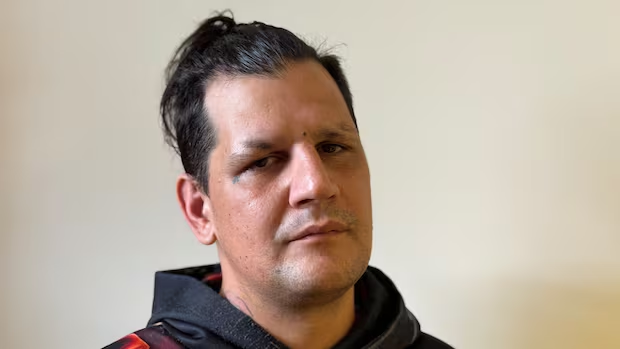
A Halifax shooting victim continues to live with anxiety and fear after being shot four times earlier this month — the blast breaking his ribs and narrowly missing his heart and lungs — in a new city-run park that was built despite community safety concerns.
“One shot scraped my lung, but it didn’t puncture it. And the other ones missed my organs,” Robby Gaudet, 39, said in an exclusive interview with CBC News. He’s now recovering from his injuries and was recently discharged from hospital.
“I almost lost my life,” he said.
That he became a victim of gun violence is confusing and concerning for him. He doesn’t know why someone would roll by on an electric scooter and open fire. He said he didn’t see who did it.
The incident occurred around 1 a.m. on July 12. He was sitting by the picnic benches in the green space directly across the street from Metro Turning Point, an emergency shelter for homeless men, where he was staying.
It was the middle of the night and he had stepped outside to enjoy a few coolers with friends.
“Nobody was fighting, nobody was arguing,” he said.
“It just happened so quick, and the next thing you know, I’m in a puddle of blood,” Gaudet said about what he called a sudden, unprovoked attack. “I leaned on the ground, put pressure on my body because I knew I was shot, and I said call 911, someone call 911.”
 A picnic bench is seen at the park on Amalamek Way, across from Metro Turning Point shelter. (Paul Poirier/CBC)
The incident occurred not long after security had been pulled from the park, which opened last fall.
Shelter Nova Scotia, which runs Metro Turning Point, had paid for security at the park for several months — an unbudgeted expense of about $40,000 to $50,000 absorbed by the non-profit organization. When two security guards were needed to safely manage the green space, the city took over the responsibility and cost.
Starting in late March, the city provided security, but after “things calmed” the security service was cut in late May, according to city councillor Tony Mancini.
In the aftermath of the shooting, extra police patrols and overnight security at the park have resumed. Gaudet calls the situation “stupid.”
“All of a sudden [there’s] no security, and something tragic happens and now there’s security again,” he said. “Where were they for me?” he asked.
 Linda Wilson is CEO of Shelter Nova Scotia. (Studio Umlah)
The shooting has shone a light on years of failed advocacy to prevent a green space from being built near the shelter.
During the planning process for the new Cogswell District, Shelter Nova Scotia CEO Linda Wilson said in a statement it participated in the consultation process “over the past decade, and consistently raised concerns related to the design, location and after-hours impacts” of a public park.
But the park’s installation on a newly built one-way street, Amalamek Way, went ahead as part of a plan to increase housing density in the district.
An urgent call from the organization for stepped-up security occurred five days before the shooting, underscoring the validity of their worries. During the meeting with Halifax parks and public safety officials and councillors, Mancini said a plan was discussed to install “attractive fencing.”
For Jeff Karabanow, a Dalhousie University social work professor who helped start Out of the Cold, an emergency shelter, the incident is a “horrible” signal of the realities faced by a vulnerable and marginalized community that lives “their private lives in public spaces.”
“Most of the research has really identified that they’re the ones that primarily are the victims of violence,” he said, despite the stigma that they’re perpetrators. “It’s a perfect example of just that notion of exposure and risk.”
City spokesperson Laura Wright said fencing will be installed in the coming weeks. A sign has also been posted notifying the nightly closure of the park, and needle sweeps are happening daily.
 Jeff Karabanow, a professor of social work at Dalhousie University, helped start Out of the Cold, an emergency shelter in Halifax. (CBC)
But Karabanow said long-term supportive housing, and not a fence that locks up at night — as “there’s probably ways to get around that” — is the safety remedy.
Halifax Regional Police have said the incident was not random, however the investigator doesn’t know if Gaudet was the intended or a mistaken target. Whatever happened, it was quick, police said.
“I’m not sure how much loitering there was in between them speaking, and what had happened,” said Const. Mandy Paquet.
Police are in the process of gathering surveillance video and are canvassing the area for “people that may not want to speak with police,” she said. “It just takes some time to do the footwork.”
Employees from the shelter and someone in the area rushed to Gaudet, applying pressure to stop the bleeding.
“Grace of God, thank you and you know, Creator’s looking out for me. I’m here right now,” Gaudet said, while also expressing gratitude for the people who sprang to his aid.
 Gaudet said daily smudging is his medicine as he recovers from his gunshot wounds. (Elizabeth Chiu/CBC News)
For the father of three, whose partner died two years ago, triggering “a bad spiral,” surviving the shooting is his “second chance at life.”
“I have a brighter light, like the way I look at life now is so different,” said Gaudet.
With his physical injuries on the mend, he vows his struggle with addiction is over. Though he had a positive experience staying at Metro Turning Point, he’s forced to search for a new place to live to feel safe, he said.
Daily smudging is his medicine and his spiritual practice. He hopes these changes will help him overcome the anxiety from the shooting.
“I’m always looking over my back now and I hope one day that goes away. Man, it’s really, really stressful and scary,” Gaudet said.
MORE TOP STORIES