
Open this photo in gallery:
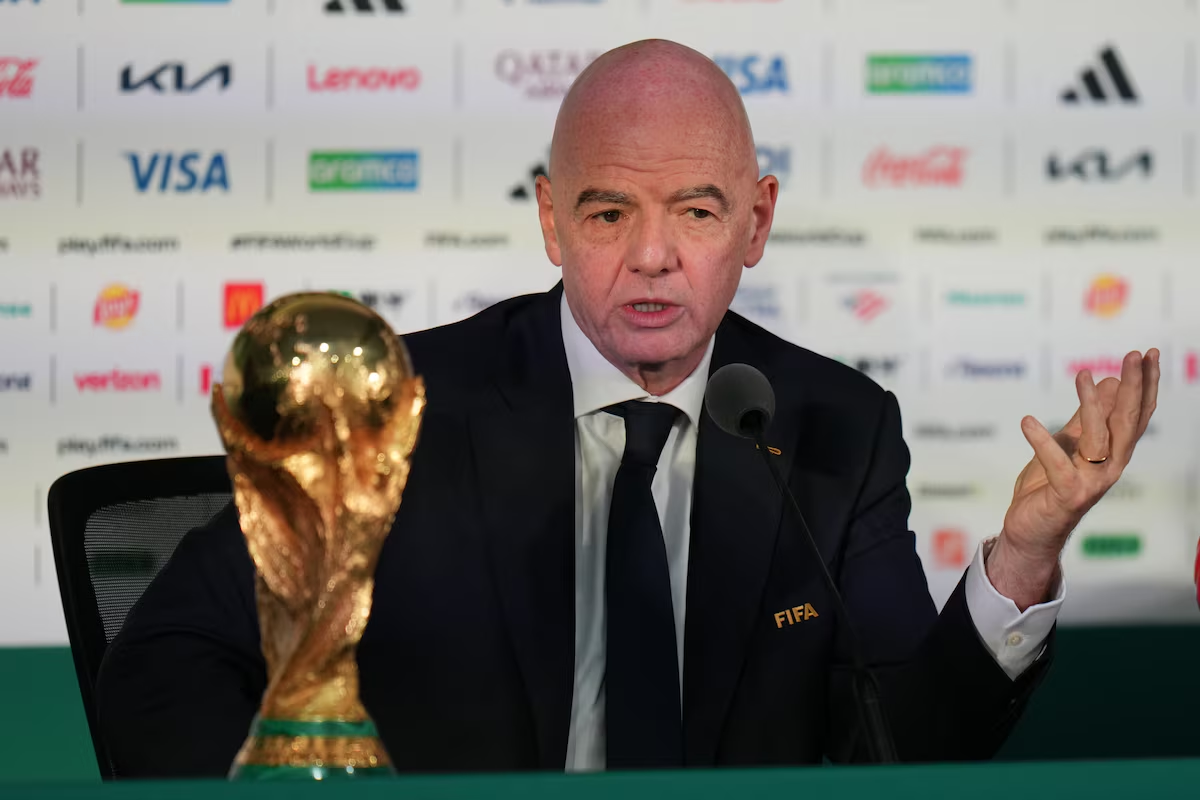
FIFA President Gianni Infantino speaks during a news conference at the stadium in Mexico City, on June 10.Eduardo Verdugo/The Associated Press
Thomas Law is a freelance writer and works for the Public History Lab at the Munk School of Global Affairs and Public Policy.
“Football’s future cannot be dictated by the expectations of those whose first duty is to maximize financial return … [It] cannot mortgage its future for financial gain.” This is how UEFA, the governing body for the sport in Europe, reacted to FIFA’s plans to sell off the World Cup to private investors.
All 55 UEFA members on Thursday unanimously agreed to boycott FIFA competitions, which would include the 2030 men’s World Cup (primarily hosted in Spain and Portugal) and the under-20 women’s tournament (in Poland in just six weeks).
It’s strong, stirring stuff that matches rhetoric with action.
So how did CONCACAF, the governing body for North America, the Caribbean and Central America, respond? By merely pointing out the procedural anomalies. In other words, if the process changed, the governing body could be open to negotiation with FIFA.
CONCACAF, UEFA nations reject Gianni Infantino’s plan to sell World Cup stakes
That is not necessarily surprising. CONCACAF has 41 members, for the most part poorer in both soccer and general terms than their European counterparts. The US$40-million that FIFA has promised each member that votes in favour of its plans would make a huge difference to, for example, the Cayman Islands.
While comparisons to Caribbean tax havens may flatter Canada’s soccer acumen, our own finances are still on a similarly precarious footing. In 2025? Canada Soccer posted its first profit for the first time in years, at just a tad over $6.5-million, and still relies on a quintet of philanthropists to employ men’s head coach Jesse Marsch. A sum of US$40-million would go a long way to building the type of long-term structures and grassroots infrastructure so sorely needed to turn Canada into a bona fide, proper soccer country.
And yet, Canada must resist selling out for its 30 pieces of silver, and if and when the time comes, do so far more forthrightly than the mealy-mouthed statement CONCACAF has mustered.
There are many reasons to explicitly reject this deal. Forget the distasteful nature of such naked and grubby commercialization. From a purely business perspective, it’s a bad deal. In essence, countries would give up guaranteed, year-on-year revenues for a one-off, lump-sum payment.
But even that one-off US$40-million payday cannot possibly be guaranteed. The new venture would be invested in and increasingly managed by American private equity, brokered by JP Morgan, and would seek short-term profit maximization above all long-term considerations for player welfare and fan appetite. That could mean further expansion of the tournament, more advertisement breaks, held more frequently, with all the North American paraphernalia that turns off soccer fans around the world, in essence threatening to kill the golden goose.
Gary Mason: The World Cup is incredible. But it’s hard to root for FIFA
Of course, there’s a long way between there and now. If FIFA doesn’t back down, and UEFA does follow through with its boycott, a World Cup without European teams would already be dead on arrival. Missing the vast majority of elite teams (nine out of the previous 12 semi-finalists in the men’s tournament, and eight in the women’s), the loss of such prestige would see a concomitant loss of media, sponsorship and ticketing revenue that no amount of Yankification could account for.
But while the first priority has to be defeating this scheme, longer term reform to world soccer is sorely needed. The good people at Reboot FIFA, an advocacy campaign, have ideas on how this can come about. The campaign seeks to amass huge quantities of irrefutable evidence of wrongdoing and corruption to pressure governments, football associations, sponsors, clubs and broadcasters to act for change.
Reform would start with ensuring the billions of dollars FIFA distributes to members is properly audited, ensuring development money goes to those who need it most, separating its commercial operations from its regulatory and governance functions and increasing transparency. We would also need to reform voting procedures so that Anguilla does not have the same power as Brazil, a country with 2,000 times the population – a structure that allows for vote share to be easily bought.
There’s a certain irony in Canada, having just co-hosted its first World Cup and riding the high of an unprecedented run. It is now faced with a choice: defy FIFA, and the promise of upfront millions, or fight for the soul of the game? Soccer’s looming civil war means that fence sitting may very well not be an option. If Canada is serious about being a soccer country, it has to live up to the true values of the beautiful game, and not the over-commercialized version that we have allowed our other sports to become.