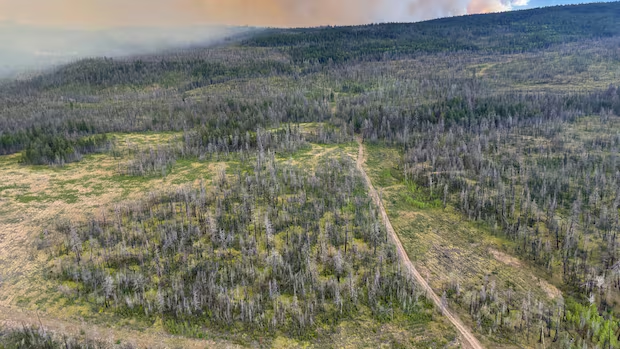
Hundreds of people are being forced to evacuate their homes in B.C.’s Interior as a fire burning out of control near Clinton, B.C., continues to threaten properties, some of which have now burned.
On Monday morning, residents of 70 Mile House were told that they must leave immediately. Hours later, the Cariboo Regional District and Stswecem’c Xget’tem First Nation issued evacuation orders for several additional properties.
The fire threatening the area, the Pear Lake wildfire, merged with the Fiftynine Creek fire on Saturday. As of Monday night, it was burning over an area of about 668 square kilometres (66,871 hectares). Officials said last week that a number of homes and businesses have been destroyed by the fire.
On Monday, Chris Webster shared photos of his father’s property just south of Clinton with CBC News, showing the fire’s destruction.
 What’s left of James Webster’s home just south of Clinton, B.C. (James Webster)
Webster said “everything changed” when the evacuation order was issued for his dad’s area on Saturday, forcing him and his neighbours to flee.
“The next 24 hours were a nightmare of constant scrolling, searching for any news while fearing the worst.”
By Saturday, Webster said, his father was able to briefly return to his home and assess the damage.
“Heartbreakingly, everything is gone.”
Webster told CBC News his father is currently in Cache Creek, waiting to find out when he can return and if any part of his life in Clinton can be salvaged.
 Images captured in the Clinton, B.C., area on July 25 show burned out cars and charred earth, as a result of wildfire that has torn through the region. (James Webster)
B.C. Wildfire Service (BCWS) fire information officer Paula Waldbauer said crews expect “extreme fire behaviour” to continue, with hot and dry conditions persisting this week.
With winds of 15-25 km/h and gusts of up to 50 km/h are in the forecast.
“We are anticipating increased growth on these incidents, our fuels remain highly impacted by the drought throughout the local area,” she said.
“We expect to see growth on the northwest quarter of this wildfire and the northeast corner of this wildfire.”
The fire, discovered about 10 days ago, was caused by lightning when thousands of strikes were recorded across the province.
 The Pear Lake fire burns on July 23. Evacuation orders related to the fire were expanded on Monday to cover 70 Mile House. (Steph Creasey)
Other fires burning in B.C.
Evacuation orders and alerts also remain in place for the area around Boston Bar in the Fraser Canyon, where the Brunswick wildfire complex, made up of the Ainsle, Brunswick and Anderson Creek fires, is burning.
As of Monday morning, that complex is a total of about 354 square kilometres in size.
 This B.C. Wildfire Service photo shows where the Ainslie Creek and Anderson Creek wildfires merged. (B.C. Wildfire Service)
BCWS said Sunday that cooler temperatures and higher humidity had moderated fire behaviour in the Fraser Canyon, and that those conditions were expected to persist early through this week.
Highway 1 remains closed in both directions between Spuzzum Creek Road and Jackass Summit due to the wildfire. Motorists are encouraged to check DriveBC for the most up-to-date information.
In the province’s southeast, the Tower Creek fire is burning out of control. While an evacuation alert for the city of Kimberley was rescinded over the weekend, properties along St. Mary’s Lake Road, from the municipal boundary of Kimberley to the Redding Creek Forest Service Road intersection, are still being asked to be ready to leave at a moment’s notice.
BCWS said it expects increased activity from the Tower Creek fire on Monday, as a result of sustained drying conditions and an “abundance” of fuel.
WATCH | Residents of 70 Mile House ordered to leave homes:
B.C. wildfires force more evacuations
B.C. residents have stepped up to help as more people flee a massive wildfire now threatening 70 Mile House after forcing evacuations in nearby Clinton. Many evacuees are sheltering in Kamloops, but space is getting tight.
A total of 133 fires were burning across the province Monday afternoon. Of those, 109 were caused by lightning, while 17 are human-caused.
Help is on the way
Wildfire personnel are coming from other jurisdictions in the coming days to help local crews, BCWS said.
Today, 25 firefighters from Yukon will arrive in B.C., and tomorrow, 66 firefighters will be coming from Alberta.
On Aug. 3, 114 personnel from Mexico are expected to join wildland firefighting efforts in British Columbia.
 A firefighter is pictured on the south flank of the Pear Lake wildfire on July 25, according to the B.C. Wildfire Service. (B.C. Wildfire Service)
Forests Minister Ravi Parmar said those crews help local firefighting personnel get some time off.
“We are maximizing all of our resources within British Columbia … this is us now planning ahead for what very well could be a challenging end to our wildfire season into August, into September.”
‘We’ve done this before’
Wildfire evacuations are nothing new for the people of Clinton. In 2017, residents were ordered to leave when the Elephant Hill wildfire came close to the village.
Erica Achtmer-Novel remembers leaving then and said evacuating this last week felt calmer.
“Everyone knew what they had to do, we’ve done this before,” she said.
The province estimates about 1,600 properties across B.C. are currently under evacuation order, while 2,900 are on evacuation alert.
Many evacuees are in Kamloops, where an emergency centre is set up at McArthur Island Sport and Event Centre, where people can get connected with accommodations, services and essential items.
Emergency operations centre director Ken Uzeloc said 460 evacuees have received support through the city’s response — including Achtmer-Novel. She stayed overnight at the city’s emergency centre over the weekend, and said she received some living essentials, including a blanket and pillow to keep.
“They give you everything you need if you don’t have it.”
Over the last decade, Kamloops has been a hub for people fleeing fires in the Interior. Deputy Mayor Dale Bass said the city has “the best emergency services, anywhere.”
“When you go out into the fires, you know it’s terrible and people are fleeing it. But they show up here and they’re greeted with a smile, maybe a hug,” Bass said.
Drought conditions in southern B.C.
The latest drought and water scarcity bulletin, issued by the Ministry of Water late last week, said that while some recent rainfall in southern B.C. has been helpful, dry conditions persist.
Streamflows are declining while temperatures rise in the southeast, where much of the province’s wildfire activity is located, the bulletin said. There are “growing concerns about the limited availability of water storage” in the south, and reports of water supply wells that are unable to meet demand, the bulletin added.
Wildfire researcher Mike Flannigan said the nature of drought is changing.
“Drought used to mean you didn’t get very much rain,” he told CBC’s Daybreak North.
But now, he said, it can also happen when high temperatures dry things out rapidly.
“Just think of hanging laundry on a line … if you put it out on [a] hot, dry, windy day, it dries really quickly as opposed to a cool, damp day. Same thing happens with our soil and with our vegetation, our fuels, the dead fuels on the forest floor.”
From July 6 to 25, daily highs have ranged from 27 to 38.1 C in Kamloops, according to Environment Canada. And, there’s been no rain.
It’s a similar situation in other parts of the Interior — especially in places where fire activity is high.
Flannigan said its important that anyone in a wildfire zone, which includes thousands of British Columbians, have a go-bag ready, just in case.
“Things can change rapidly,” he said.
He also suggested that anyone who can safely FireSmart their properties do so. That includes things like removing fuel — dry branches, grasses and other vegetation — from around a home and replacing building materials with fire-resistant ones where possible.
Experts say that while fire is a natural part of Canada’s forests, human-caused climate change has led to more extreme and more frequent natural disasters, including wildfires.