
Open this photo in gallery:
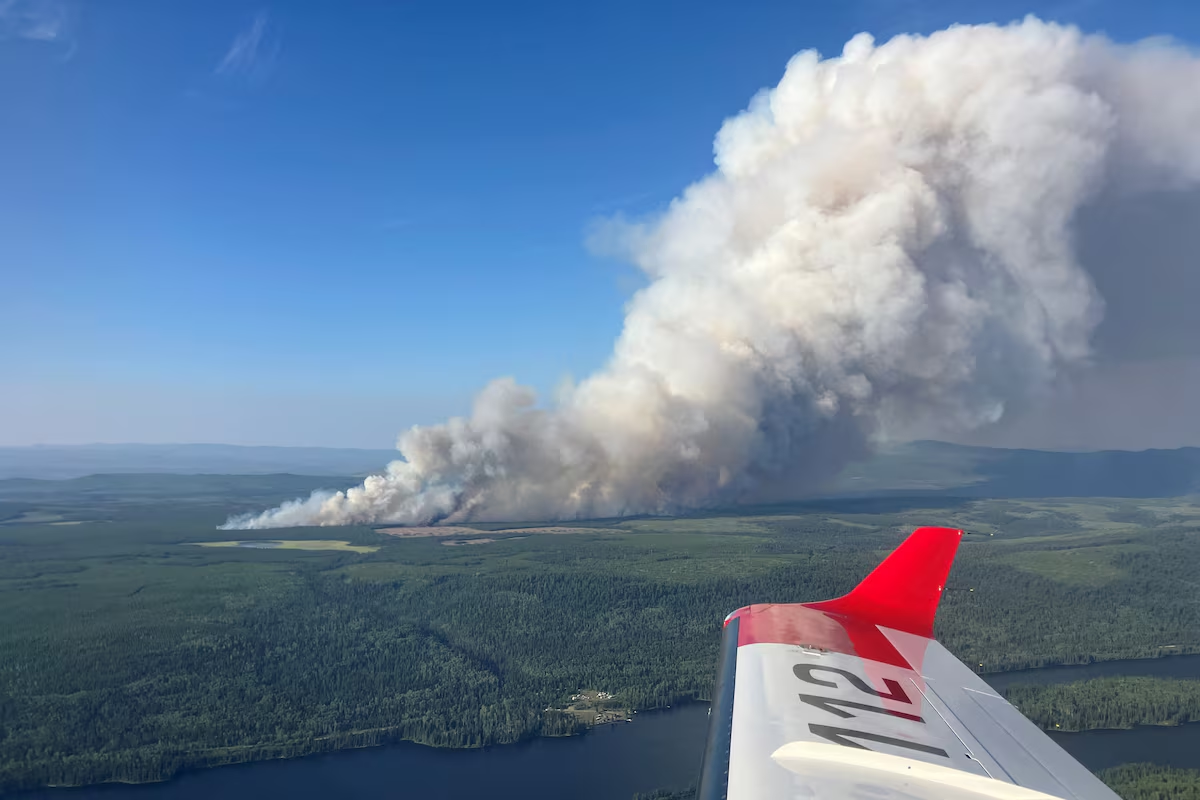
Smoke rises from the Pear Lake wildfire, which has forced the evacuation of the nearby town of Clinton, B.C., on Thursday.BC Wildfire Service/Reuters
The tiny British Columbia town of Clinton was founded during a gold rush and has its 150 years of history baked into its streets. But as wildfires to the north and west close in and residents are ordered to leave, its future is uncertain.
Helene Cade, 94, was a young schoolteacher when she moved to Clinton around 72 years ago from the province’s coast. Now, the former president of the town’s museum said she’ll have to choose which photos of her kids she keeps with her as she evacuates from the seniors’ care home she lives in.
“I’m finding it hard to leave things that I know I can’t take with me,” she said.
The town of more than 650 people about 100 kilometres northwest of Kamloops has been placed under an evacuation order as of Friday. The state of the Pear Lake fire, west of the town, led to the order, according to the Thompson-Nicola Regional District.
Three fires – Pear Lake, Fiftynine Creek and French Bar Creek – are burning around 35,000 hectares in the area close to Clinton.
In other parts of the southern Interior, Kimberley has been on an evacuation alert since July 19 as a result of a large wildfire complex, while an evacuation order was declared on July 21 in Boston Bar – where fires continue to grow.
A mix of hot conditions and lightning strikes are mostly responsible for the fires. This year’s wildfire season is expected to be as harsh as some of the worst on record, with projections ranking it among the devastating years of 2017, 2018 and 2021.
As the town of Clinton evacuates, Ms. Cade isn’t worried about everybody getting out.
“As a small town, everybody, pretty well, almost everybody knows there’s somebody else,” she said. “Nobody gets left behind.”
The skies have been smoky every day, said Nav Singh, who runs a gas station and the only grocery store in Clinton. Mr. Singh said he’ll be staying open for as long as possible before evacuating, to provide emergency services and firefighters with fuel.
Mr. Singh, who came to Clinton five years ago, said the townspeople know how to react because of a wildfire that devastated the region in 2017. The town was evacuated in July of that year, but no structures were damaged.
Glenn McGillivray: Why humans can’t outfight Canada’s boreal fires
This year, approximately 20 properties have been affected in the region by the Fiftynine Creek wildfire, Colton Davies, communications manager at the Thompson-Nicola Regional District, said in an e-mail.
In addition, Mr. Davies said at least a dozen homes were lost at Big Bar lake, where the fire has been burning since last Friday, around 25 km north of Clinton.
Wildfire smoke, mostly stemming from fires 130 km south of Clinton in the Fraser Canyon, continues to engulf much of the southern interior region of B.C., and is expected to stick around for another 24 to 48 hours.
While air quality is improving in parts of the Interior – such as regions in the Okanagan and Nicola Valley – conditions have worsened elsewhere. The Fraser Canyon and the South Thompson were under air-quality warnings Friday afternoon.
Environment Canada says smoke conditions can vary considerably hour by hour during a wildfire.
Kelowna had the worst air quality in the world Thursday afternoon, according to the website IQAir, but since, Environment Canada has noted that air quality has improved.
Residents said the air quality improved on Friday, allowing tourist activities and business operations to resume as usual.
Open this photo in gallery:
Smoke rises over the Bourgeois Creek wildfire northwest of Quesnel, B.C., earlier this week.BC Wildfire Service/Reuters
Ryan Watters, a communications adviser at Kelowna International Airport, said wildfire smoke and heavy winds caused flight delays and cancellations Thursday, but the conditions on Friday haven’t led to disruptions.
The smoke on Thursday also caused the B.C. Summer Games, the province’s largest biennial multisport event, being held in Kelowna, to move the rest of the planned events for the day indoors.
Thousands of young athletes travelled to Kelowna this week to participate in the Games, which were last held in the city in 2008.
Alison Noble, president of the BC Games Society, said the programming resumed as usual Friday as the air quality improved and that despite the changes to Thursday’s schedule, the “athlete energy has remained very high.”
What to know about Ontario’s approach to fighting wildfires up north
Ellen Walker-Matthews, the CEO of the Thompson Okanagan Tourism Association, said tourists in the region are simply getting used to the smoke and working their plans around it.
She noted that wineries were a popular choice for tourists Thursday even as the thick smoke and hazy skies disrupted visitors’ beach-day plans down at Okanagan Lake.
“We certainly are concerned for our friends and neighbours that are having fires. That’s the more concerning thing – that they’re safe, and that our firefighters are safe,” Ms. Walker-Matthews said.
“So, a little smoke won’t hurt us.”