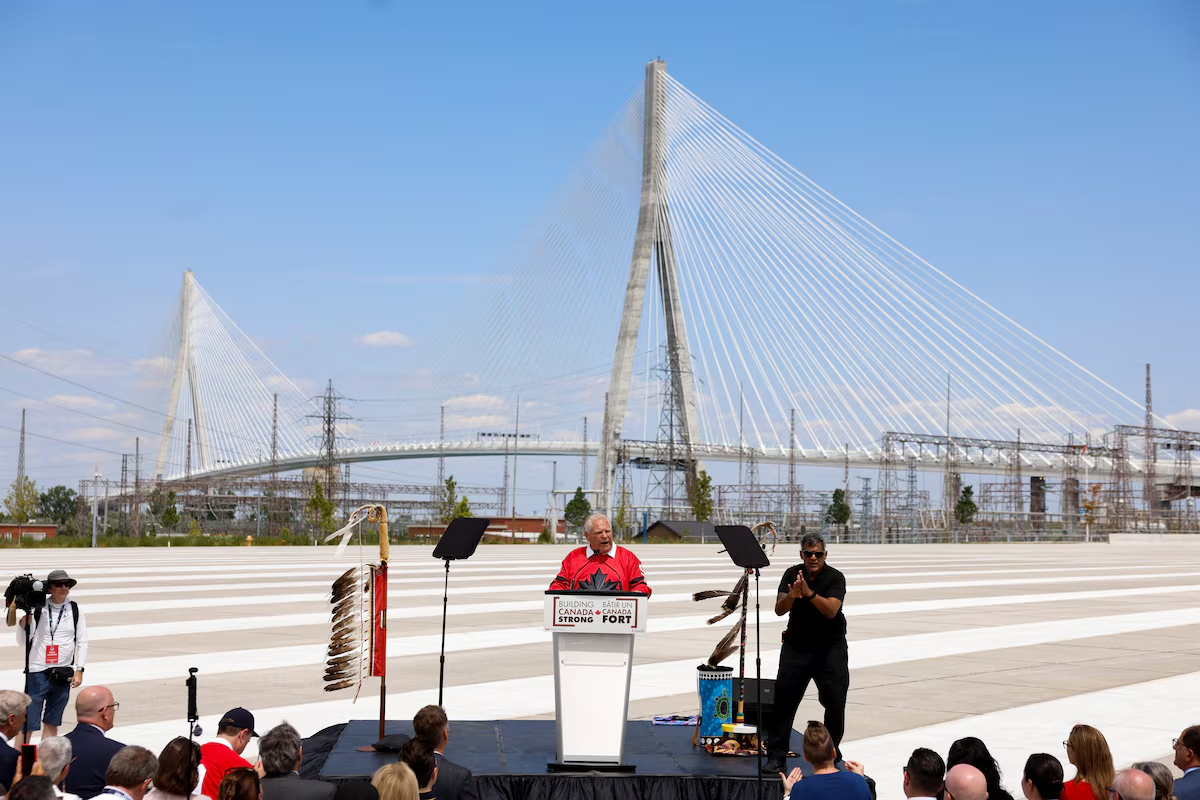

More than two decades of planning and construction for the $6.4-billion Gordie Howe International bridge culminated Friday in a ceremony attended by a Canadian premier, ambassador and a federal minister, but no U.S. representatives.
This distinctly Canadian ceremony marked the official opening of a bridge between Windsor and Detroit that has been 25 years in the making.
The first vehicle will traverse the bridge on Monday – a new crossing at the busiest border point between the U.S. and Canada. Its competitor – the Ambassador Bridge – has been the only bridge to service the intertwined communities for more than a hundred years.
Premier Doug Ford stood next to federal Infrastructure Minister Gregor Robertson, Canadian Ambassador to the United States Mark Wiseman and Windsor Mayor Drew Dilkens to cut the red ribbon. Behind the party, the 220-metre-tall towers of the new bridge stretched into the sky.
A three-piece band played Just the two of us and Ain’t no sunshine while children played ball hockey.
The bridge is shaped to look like a hockey stick in honour of its namesake: the Canadian-born hockey legend who took the Detroit Red Wings to four Stanley Cup triumphs.
What to know so far about the Gordie Howe bridge deal
The name of the bridge is a “tremendous honour” Gordie Howe’s son Mark told The Globe and Mail. It also fittingly represents the kind of human being his father was, he said, adding that his dad loved people and building connections between them.
But this sense of camaraderie was in short supply on Friday morning. American representatives were uninvited to the celebration. Democratic State Senator Erika Geiss told The Globe that her invitation was rescinded shortly after U.S. President Donald Trump threatened 50-per-cent tariffs against Canada.
The ceremony also didn’t happen in the centre of the bridge, as Mr. Dilkens told The Globe he had long envisioned. It happened on the Canadian side, on the ramp leading up to the bridge. Mr. Dilkens said that is a symbol of the tense relations between the U.S. and Canada.
“In normal times, this would be the type of event at a scale that happens so infrequently,” said Mr. Dilkens, who added that it also shouldn’t come as a surprise given Mr. Trump’s threat of tariffs on Monday.
“How could we possibly in good faith celebrate with folks from the United States at this particular point in time?”
Open this photo in gallery:
Ontario Premier Doug Ford speaks during an event ahead of the opening of the Gordie Howe bridge on Friday.Carlos Osorio/Reuters
Gordie Howe bridge deal appears to contradict Carney’s description of pact with U.S.
The bridge opening has been mired in uncertainty and controversy since February when Mr. Trump took to Truth Social to argue that the U.S. should own half of the bridge. Fourteen years ago, when the deal over the bridge was first signed, Ottawa agreed to pay the full sum. It would cover these costs by receiving the full revenues from tolls.
But a planned opening of the bridge – scheduled for June – was delayed by the White House. The owner of the Ambassador Bridge had spent $1-million on campaign financing and hired a lobbyist firm with connections to the Trump administration, according to reporting from The Globe.
Then, under a side deal announced earlier this month, Ottawa agreed to split equally with the United States “net bridge and crossing related revenues” for the first 15 years. The revenues will be divided between the two countries after operating costs are deducted.
The agreement says that the money will be paid by Canada to an economic development fund “established and solely controlled” by the U.S.
It does not include a clause that allows Canada to cover its debt-servicing costs for the bridge before splitting the revenues with the U.S. That contradicts what Prime Minister Mark Carney told CTV on Sunday about debt when he played down the amount of money that would be sent to the U.S.
Mr. Trump took to social media while the ceremony was under way, saying that the cancellation of the joint event was “fine, considering they are paying substantial TARIFFS to the United States,” and noting that the U.S. had negotiated a better deal for the bridge.
“We changed the terms of the Deal so that the United States of America now gets 50% of the Profit,” he posted to Truth Social.
To Mark Howe – one of 30 of his family who came to Windsor for the bridge opening – the controversy and “turmoil” between Canada and the U.S. is “unfortunate.” Mr. Howe considers both countries to be home. Born in Detroit, and a hockey hall of famer in his own right (inducted in 2011), Mr. Howe remembers countless nights on Highway 401 travelling across Ontario and Michigan for tournaments.
“When I come to Canada, it is not a foreign country.”
For the trucking community, the ceremony is significant, regardless of geopolitics.
The bridge is “game-changing” when it comes to efficiency, said Michael Sbrocchi, vice-president of sales for Speedy Transport Group, Inc, a Canada-wide trucking company. Speedy’s trucks will drive across the bridge between 80 and 100 times a year. The new bridge will cut down on average crossing time by 15 minutes.
“Everyone wants to politicize this,” he said. “But we need to be grateful as an industry that a piece of infrastructure this large was built.”
The Gordie Howe International Bridge is the most technologically advanced border crossing in Canada, said Steve Dewitt, the chief executive of Bridging North America.
It is the longest cable-stayed bridge in North America, suspended above the Detroit River by 216 cables and 4,500 tonnes of steel bars. It is the culmination of 20 million hours of work conducted by more than 15,000 people. The crossing has 24 inspection lanes, 16 toll lanes, advanced screening technology for examining inside trucks and is directly fed by Highway 401 and Michigan’s Interstate-75.
Direct highway access and many new inspection lanes will – depending on the size of the trucking company – drive cost savings between $20,000 and $100,000 a year, said Stephen Laskowski, president of the Canadian Trucking Alliance.
The communities of Windsor and Detroit will also face less truck traffic in their neighborhoods, said Mr. Dilkens, the Windsor mayor. The multiuse bridge will mean Canadians and Americans on either side of the river can walk or bike across the border for the first time in at least fifty years. And that should be celebrated, he said.
“This is a nice celebratory event for the Canadians who actually paid for the event, who actually pushed for construction of the bridge and who got it done.” said Mr. Dilkens.
The legacy of these benefits will outlast the fight between Canada and the U.S., said Mr. Howe.
“It’s kind of like when two guys have a disagreement on the ice,” he said. “Sometimes a fight breaks out, you have to throw some fists and elbows but sooner or later they develop a respect for each other.”
With a report from Marieke Walsh
Editor’s note: This article has been corrected to state that the ceremony occurred on Friday.