
Open this photo in gallery:
Prime Minister Mark Carney takes questions from journalists outside the Office of the Prime Minister and Privy Council in Ottawa on Tuesday.Justin Tang/The Canadian Press
Prime Minister Mark Carney has convened a cabinet-level emergency committee to co-ordinate the federal response to almost 900 wildfires burning across the country.
The Incident Response Group, comprised of ministers and senior officials, will aim to synchronize Ottawa’s “urgent assistance” in the crisis wherever it’s needed, according to a statement released by the Prime Minister’s Office.
The IRG, however, falls short of calls earlier this week by premiers for the federal government to come up with a national wildfire strategy that still respects a province’s autonomy to make decisions on wildfire fighting resources.
There are more than 890 wildfires burning across Canada. Huge blazes in Northwestern Ontario have razed entire communities and prompted the evacuation of hundreds of people. More than three million hectares have burned, putting this fire season on track to be among the largest in Canadian history.
Some 3,000 people in the country have had to leave their homes, according to the PMO’s statement.
“Our government will continue to work closely with provincial, territorial, and Indigenous partners to support affected communities and deploy every resource needed to keep Canadians safe,” Mr. Carney said in a statement on social-media platform X.
Canada wildfire maps: Where and how many are currently burning
Wildfire behaviour has escalated sharply across the country in the past week.
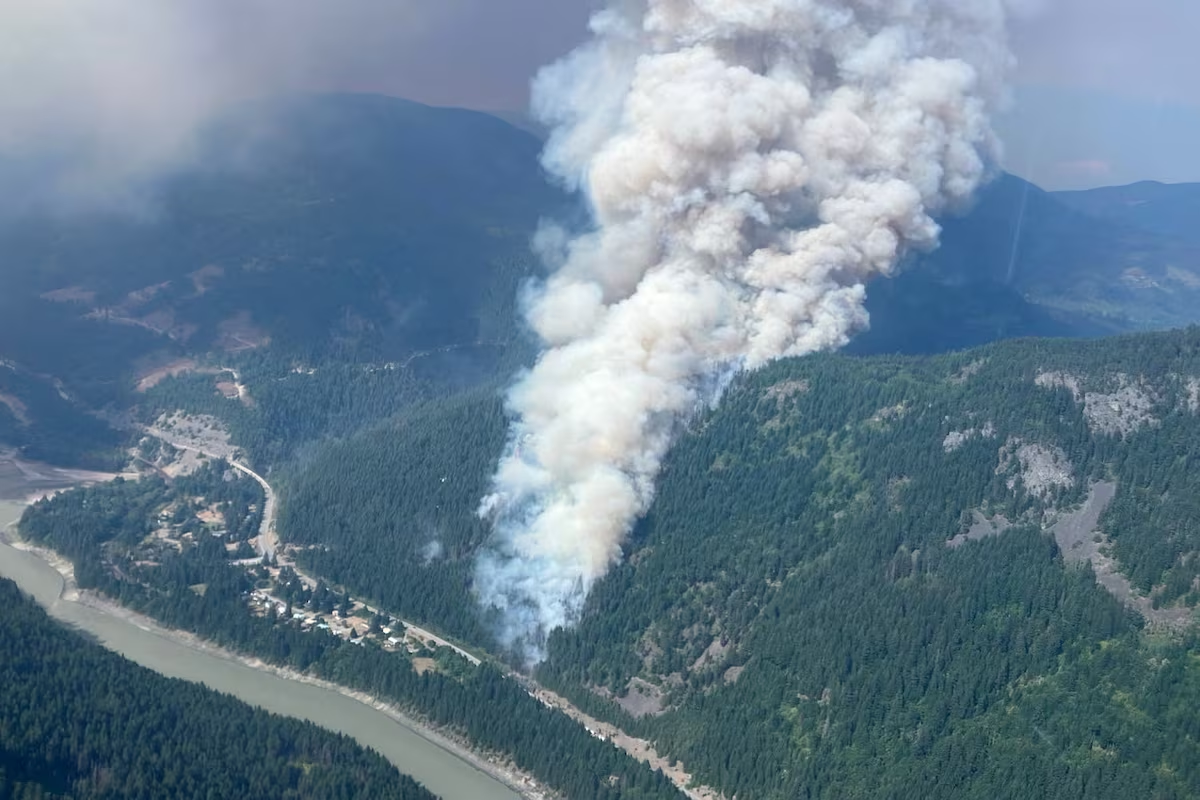
On Tuesday, a new fire in B.C.’s Fraser Canyon exploded in size, growing to 43 square kilometres overnight. Its heat and smoke merged with that from two nearby fires, launching a massive pyrocumulus cloud so high into the sky that it could be seen from as far away as Vancouver, 200 kilometres to the southwest.
The three fires have now encircled the community of Boston Bar, which has been under an evacuation order for weeks, prompting the Fraser Valley Regional District to issue an emergency alert urging residents who’d defied the earlier orders to leave immediately.
“You are in danger,” the district’s statement said. “For your safety, residents who have remained in the community must leave now.”
Kyle Wood was one of those residents. He had originally evacuated from Boston Bar when the first orders were given and the highway through town was closed. But as conditions appeared to improve and the highway was reopened, he decided to go home despite the order.
Open this photo in gallery:
Smoke rises on Tuesday over the Fraser River from the Anderson Creek wildfire, which led to the latest evacuation of nearby Boston Bar, B.C.BC Wildfire Service/Reuters
On his way home, he wound up driving past the new wildfire just as it was starting in the trees beside the highway.
“It was pretty big at that point. Trees were already candling,” he said. When he reached his home in downtown Boston Bar, he and his son went to his father’s place in nearby North Bend to warn him.
“By the time we got to North Bend, half the mountain was on fire,” he said. The family raced to pack some belongings and leave, but by then, the highway south of town was closed, and the only escape route lay north along Highway 1 through the canyon and eventually to Kamloops.
Mr. Wood said there were very few people left in Boston Bar who hadn’t already followed the earlier evacuation orders. His father had stayed throughout the ordeal, Mr. Wood said, and the past few days of cooler temperatures and lower fire behaviour made things seem less worrisome.
BC Wildfire Service spokesperson Gord Robinson said the new fire was initially spotted by helicopters. Fire behaviour reached rank 6 – the highest on B.C.’s scale – so quickly that it was impossible for crews to attack directly.
Instead, firefighters focused on protecting houses and other nearby structures. Fortunately, the fire appears to have grown mostly uphill, climbing the mountainside east above town.
Peter Kuitenbrouwer: Canada’s forest industry plays a big part in the wildfire problem. Will it be part of the solution?
Further east, an incident commander for a complex of fires burning near Kimberley, B.C., said more resources were on the way to help firefighters as heat peaks this week.
Environment Canada predicts temperatures in the region may reach well into the 30s for the next two days as a ridge of high pressure moves across the province.
Environment Canada has issued air-quality advisories covering much of B.C. because of smoke from about 90 wildfires.
“Increasing temperatures and limited precipitation will continue to reduce fuel moisture levels, elevating the potential for new wildfire starts,” it said.
The wildfire situation was on the minds of premiers as they met in Charlottetown on Wednesday.
Northwest Territories Premier R.J. Simpson told reporters that there are 200 active wildfires in his territory, with almost a million hectares burned so far.
First Nations chiefs demand public inquiry, resignations over Ontario’s wildfire response
Ontario Premier Doug Ford has faced a growing chorus of criticism for his province’s handling of the wildfire situation, including calls from Northern Ontario First Nations leaders for the head of Ontario’s forest-fire agency to resign.
But Mr. Ford has pushed back against some First Nations who have said that his government was unprepared to deal with the wildfires.
“I totally disagree with that comment. We have constant communication. We’re going out to the First Nations. We’ve moved close to 2,000 First Nations communities” on planes, the Premier told reporters Tuesday. He added that they’ve been provided with hotels, food and any other expenses.
Mr. Ford then said that First Nations communities are the responsibility of the federal government.
“On-reserve, the feds have the responsibility to take care of First Nations, but we’re taking care of them. We’re doing everything we possibly can,” he said.
He said the province has 155 fire crews on sites, close to 800 or 900 wildland firefighters, and that relief efforts are “well-organized” in Thunder Bay.
“I saw every single office. We saw all the meals being prepared. The Red Cross, all the other organizations, Ontario Corps. Everyone is helping out. So, I totally disagree with their comments.”
With reports from The Canadian Press