
Open this photo in gallery:
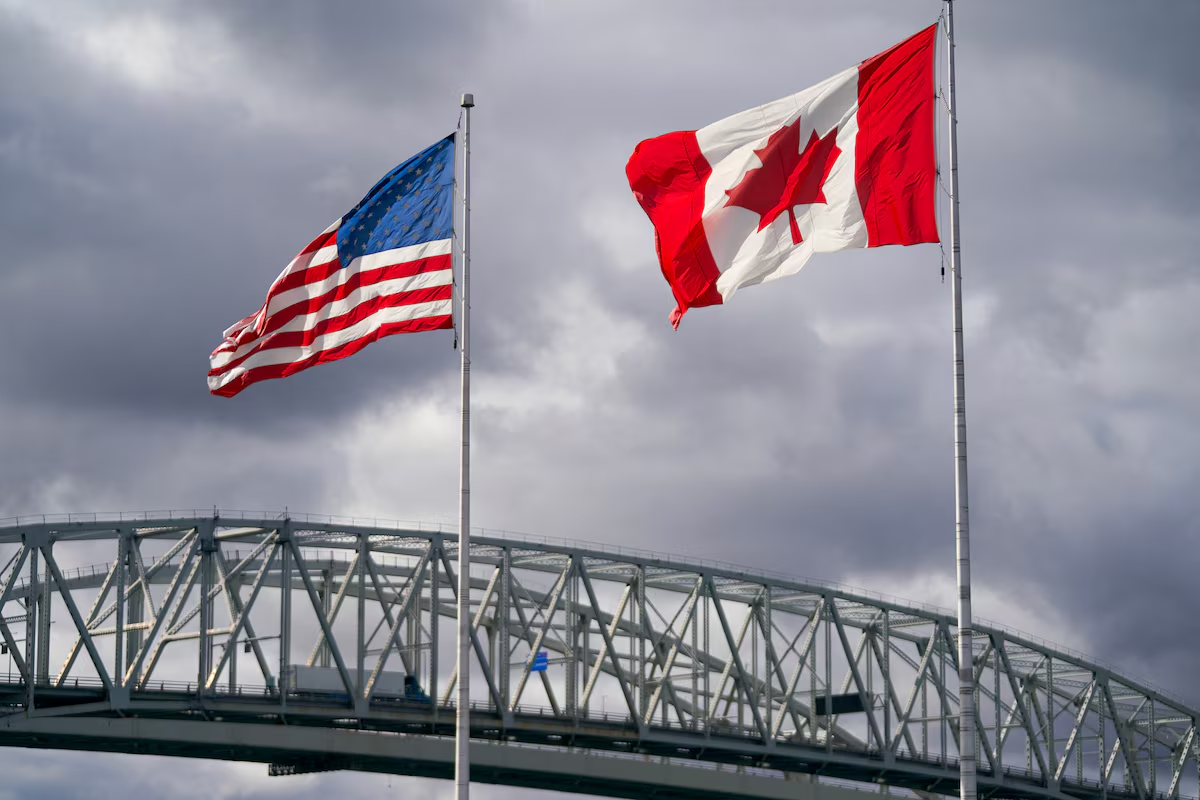
The American and Canadian flags flutter next to the Blue Water Bridge border crossing in Point Edward, Ont.GEOFF ROBINS/AFP/Getty Images
Jeff Mahon is director of geopolitical and international business advisory at consulting firm StrategyCorp. He previously served as deputy director at Global Affairs Canada’s China Division.
As U.S. President Donald Trump unleashes brand new tariffs, Canadian trade policy is at risk of tying itself up into a knot of contradiction.
Monday evening, Mr. Trump imposed expansive tariffs of 50 per cent on Canadian exports. These tariffs, on goods ranging from wine to cement, are framed as defensive measures against Canadian trade policy, after increasing bilateral friction.
Against the Trump administration’s ongoing heel-turn, this country is struggling in its attempt to implement the opposing trade doctrines of integration and diversification.
Canada has been trying to secure needed preferential access to the U.S. market, but that comes with the cost of building “Fortress North America,” a synonym for aligning external economic security policy. While potentially a solution, it could also erode Canadian autonomy in foreign affairs and inhibit the emergence of new supply chains and commercial relationships with the rest of the world.
Meanwhile, Canada has sought a renewed partnership with China. In January, Prime Minister Mark Carney reached a deal with China that introduced a tariff rate quota for Chinese-made electric vehicles and opened the door for China to invest in the sector in return for Beijing reducing retaliatory levies on canola products and other agricultural shipments from Canada. The agreement paved the path for increased trade and investment to offset losses with the U.S. But the negotiations for the United States–Mexico–Canada Agreement – in which the U.S. seeks to restrict parties’ trade with others – threaten to bring down this deal and put Canadian exports to a key diversification market in jeopardy.
Carney offered to double oil exports to U.S. as part of potential deal, Hoekstra says
Monday’s tariffs, declared suddenly by a capricious leader, are a reminder that the world has changed. To maintain autonomy and prosper, Canada must dissolve the contradiction in its trade policy. Mr. Carney’s “variable geometry” on issue-based alignment forging is meant to deal with this, but the concept needs to be further fleshed out and made practicable.
We must first understand how our economy is structured and maps to different markets. It can be broken into three areas.
Natural resources and agriculture are commodities with fungible demand which, with the appropriate export infrastructure in place, Canada can export freely to world markets – buying wealth and geopolitical capital.
Manufacturing is subject to more market-specific demand forces, in which proximity and regional standards shape trade flows. For products such as steel and automobiles there is no viable alternative to the U.S. market, hence the existential threat posed to these industries by Trump’s tariffs.
Lastly, there is the digital sector. Canada’s tech sector has been dominated by Silicon Valley where many of Canada’s best startups and R&D are sold off and commercialized. The implications for sovereignty are far-reaching in this industry and Canada should retain the autonomy to balance our commercial and societal interests.
Within this breakdown there are layers of specific sectors or products where the strategic considerations are more or less relevant. Critical minerals, for example, arose as a subset of the natural resources sector because global processing capacity is largely concentrated in a single country, China, thus creating a chokepoint vulnerability. In response, new frameworks are being developed that are intended to create a separate market structure linking together concerned governments, investors, buyers and sellers.
Globalization isn’t staring off a rupture so much as splintering into a world of multiplex markets.
Tim Shufelt: Trade limbo is quietly taking a heavy economic toll
The bottom line is that Canada must have different, specific trade policies for each market. And the country needs mechanisms to manage the policy implications and political risks associated with this emerging new order.
To salvage our trade relationship with the U.S., Canada should propose revitalizing the North American Competitiveness Council, a tri-nation advisory group, to place a greater emphasis on economic security. This would align with Fortress North America thinking. With a renewed mandate, the council could track international commercial developments and their impact on shared continental interests, and co-ordinate the development of common external policies in select sectors. It could thus serve as a platform for dealing with the contentious Section 232 tariffs, levied under a national security pretext.
Canada needs a similar platform for managing our engagement with China. That country has essentially commodified manufacturing and disrupted the cost-benefit consideration between cheap consumption and domestic production for other countries. This state-fostered economic transformation has inevitably created security anxieties among liberal market democracies.
A permanent bilateral working group should be established to determine the extent and limits of our commercial relationship. It must be tasked to go beyond dialogue to regularly identify sensitive sectors and establish conditions for investment and trade, while identifying each country’s red lines.
Monday’s tariffs aim to force Canada’s hand.
The only solution is for Mr. Carney to implement his variable geometry in a world of multiplex markets. In order to do that, he must take his own Davos speech advice: Canada has to be at the table to avoid being on the menu.