
Open this photo in gallery:
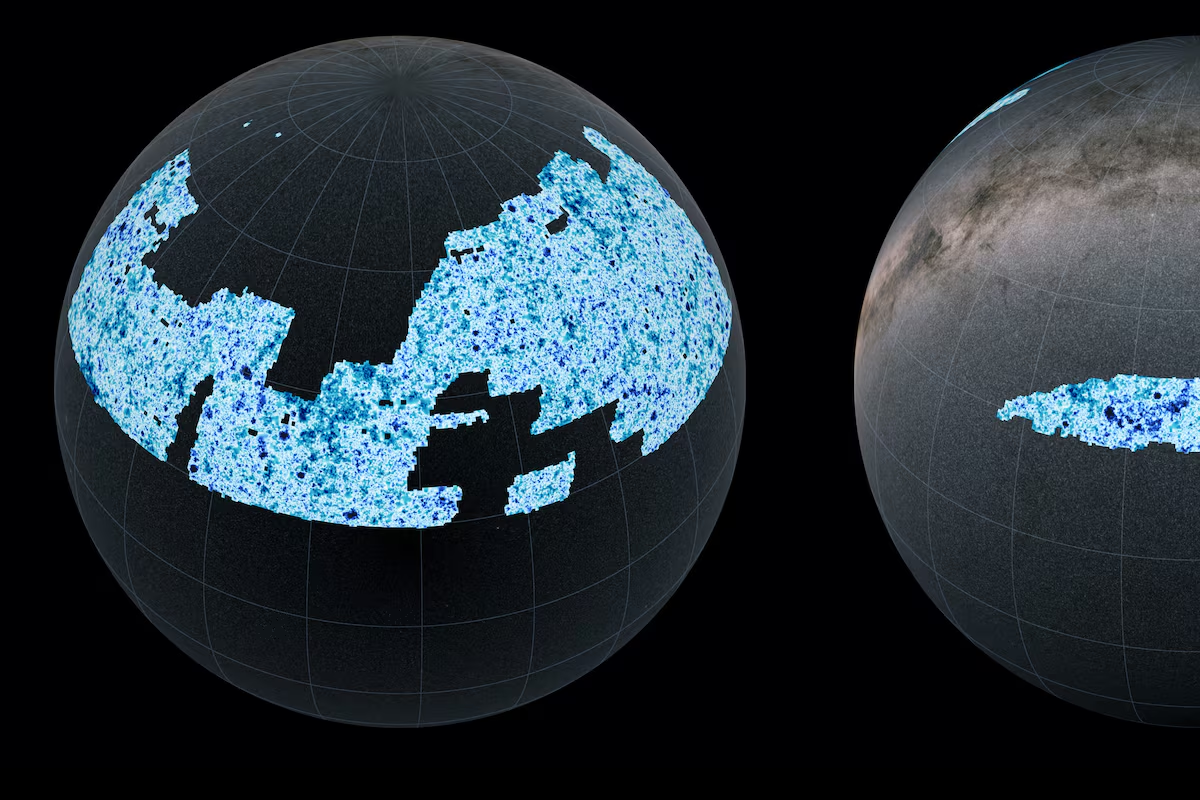
The map, Courtesy UNIONS survey and University of Waterloo, is the latest effort to chart how dark matter is distributed in space.UNIONS survey and University of Waterloo
Call it the search for things that go clump in the night.
Based on a survey of 62 million galaxies, a team of astronomers in Canada, Europe and the United States has produced the most extensive map yet of the mysterious phenomenon known as dark matter as it appears in the skies above the Northern Hemisphere.
The map is the latest effort to chart how dark matter is distributed in space. It draws on nearly a decade’s worth of observations made with the Canada-France-Hawaii Telescope atop Mauna Kea on the Big Island of Hawaii as part of a long-running project called the Ultraviolet Near Infrared Optical Northern Survey, or UNIONS.
While the map is preliminary – a more complete version is yet to come – it shows enough for researchers to weigh in on a key question: Is the arrangement of matter in the universe as clumpy as it should be based on the the leading theory of the cosmos?
Contrary to some earlier findings, the new results appear to say yes.
“Our message is don’t panic,” said Mike Hudson, a professor of physics and astronomy at the University of Waterloo and a member of the team behind the dark matter map. “We don’t have a conflict at the moment with the standard picture.”
The result is significant for theorists trying to build a coherent story of the evolution of the universe using a range of different observations, some of which don’t quite match up.
The search for Semeniuk: My years-long quest to find my namesake asteroid
Most say that story begins with the Big Bang, an explosive event that initiated the expansion of the universe some 13.8 billion years ago.
Out of the energy of the Big Bang sprang the particles of matter that make up hydrogen and other atoms, some of which became the galaxies, stars and planets we observe in the universe today.
But a much larger share of the universe’s mass – about 85 per cent – came into existence as dark matter. As the name suggests, it is a substance that gives off no light or any other form of energy that scientists have thus far been able to detect.
The nature of dark matter remains unknown, though many researchers suspect it is a type of particle or particles yet to be generated or identified by physics experiments conducted on Earth.
Awareness of dark matter’s existence came gradually as astronomers in the 20th century realized there was a large quantity of extra mass in the universe that was unseen but could be perceived indirectly, through its gravitational effects on stars and galaxies.
The UNIONS survey makes use of one such effect, called “weak lensing.”
Just as a warped sheet of glass can distort how objects appear through it, the gravity of dark matter bends the path of incoming light and alters the shapes of galaxies located farther away. Astronomers have learned to spot these shape changes and then work out how dark matter must be positioned in space in order to cause them.
“These are extremely challenging measurements,” said Dr. Hudson. “The distortions are tiny: about one part in a thousand.”
The resulting map shows where dark matter is most concentrated in two patches of the northern sky separated by the glowing band of the Milky Way, which blocks the view of more distant galaxies used by the survey.
Such maps can be used to test which theories are most effective at reproducing the way dark matter is arranged across vast volumes of space.
As a starting point, it’s known that the universe was remarkably uniform in the immediate aftermath of the Big Bang. But over billions of years of cosmic history, slight differences in the density of dark matter grew into giant clumps as material coalesced under the influence of gravity.
Ordinary matter was also pulled into these clumps so galaxies began forming in places were dark matter is most concentrated.
The theory of how the universe evolved predicts how large and dominant the clumps should be by now. In recent years, efforts to map dark matter have led to results that seem too smooth to fit that picture. Cosmologists refer to this problem as the “S8 tension” in reference to a mathematical equation that describes how unevenly the mass in the universe is distributed.
The new dark matter map seems to allay that problem, but Dr. Hudson cautioned that it’s too early to be sure.
“We need more data to reduce the statistical uncertainties,” he said. “This will come as we expand the area that is being analyzed.”
The next step, he added, is to separate the galaxies in the survey by distance. This will allow astronomers to turn the the two-dimensional map into a three-dimensional picture of where dark matter resides in a region that lies two to eight billion light years from the Milky Way.
The work will involve additional observatories including Japan’s Subaru Telescope, also based in Hawaii. The work complements other surveys underway in the Southern Hemisphere.
Another important aspect of the work is connecting it to measurements of dark matter in the early universe, which can be detected by other means.
This week about 200 astronomers are meeting in Toronto to advance their work on the Simons Observatory, a dark matter experiment, currently under construction in the Atacama Desert in Chile.
“It’s a great moment for Canada in the sphere of cosmology,” said Adam Hincks, a University of Toronto researcher and one of the organizers of the conference