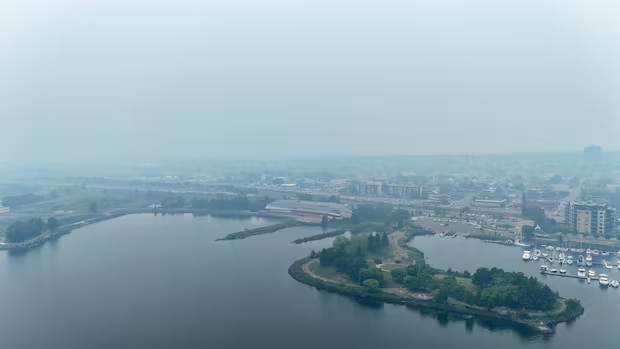
Ontario’s wildland firefighters are facing “extremely challenging” conditions on the ground in northwestern Ontario, their union said.
More than 150 crews were deployed to northwestern Ontario as of Friday morning, including some from Alberta and the Yukon.
As of Thursday evening, there were 129 active fires burning in northwestern Ontario, the provincial Aviation, Forest Fire and Emergency Services agency said. Of those, 62 were not under control, five were being held, four were under control, and 58 were being observed.
“A lot of people aren’t even direct attack on any of these fires,” said Eric Davidson, vice-president of OPSEU Local 728 in Red Lake. “It sounds like the values structure protection, that’s the name of the game right now, making sure people aren’t in the way.”
“With the smoke, it sounds like a lot of aircraft aren’t even flying, just with no visibility,” he said. “So they’re struggling just to even get access to a lot of the stuff that’s out in front of the fires.”
WATCH | Ford calls opposition’s claim he cut firefighting budget ‘despicable’:
Ford calls opposition’s claim he cut firefighting budget ‘despicable’
Premier Doug Ford lashed out at opposition parties who have pointed out in recent days that the Ontario government’s firefighting budget for this year is just $150 million, even though last year the province spent $271 million. Ford said the government won’t spare any expense in battling the fires in northwestern Ontario this summer.
Davidson said wildland firefighters generally work a schedule of 19 days on, two off.
“The schedules are supposed to be fairly similar across the bases, but generally it’s 19 and two, with 14 fire line days in a row,” he said. “Usually they can work 16 hours, but in emergency scenarios, they might be working eighteens, or I’ve heard of even longer with approval.”
That means firefighters sleep in the bush for those 14 days on the fire line.
“You come home, you get two days pretty much to kind of get your bags ready, maybe pay some bills if you haven’t done that or you haven’t been able to do that,” he said. “You talk to some of your loved ones, and then often when it’s busy like this, you just go right back out.”
And, Davidson said, there’s a shortfall when it comes to staffing.
WATCH | Wildfires continue to rage across Ontario, forcing more evacuations:
Wildfires continue to rage across Ontario, forcing more evacuations
More communities are under evacuation orders as wildfires rage across Ontario, with smoke affecting air quality across much of the province. Ontario Premier Doug Ford says the province is throwing all resources at the response.
“Here in Red Lake, we have eight crews,” he said. “We’re supposed to have 15. There’s a lot of empty lockers here and I think that’s kind of echoed across the province.”
“There’s a few bases that are doing OK, but I think, you know, it’s kind of more of a people-being-promoted-before-they’re-ready and then just to fill those numbers so it doesn’t look as bad as it as it would.”
Davidson said some wildland firefighter positions were reclassified by the province in the spring.
“Each crew is made-up of usually two or three crew members, a senior crew member, which is like the second in command, and then a crew leader who’s like in command of the crew,” he said. “Those positions were all reclassified. They were all bumped up one position, but we were looking for like a firefighter classification.”
“Everyone in the Bush is still classified as a resource technician in some capacity,” he said. “When the government comes out and says, ‘oh, our firefighters or whatever on the front line,’ we don’t have any firefighters. We have resource technicians, and often the pay and wage scales reflect that.”
WATCH | Ford: Ontario will not spare any expense to fight wildfires:
Ford: Ontario will not spare any expense to fight wildfires
Ontario Premier Doug Ford defended his government’s budget for wildfire response Friday as the province asked the federal government to be ready to help evacuate northern communities where nearby fires are burning out of control.
At a media conference Friday, Ontario Premier Doug Ford said the province has spent nearly $1.5 billion on wildland firefighting since 2018, and has increased base funding from $70 milliion annually when the government took office, to $150 million today.
“That base funding ensures that firefighters, aircraft and equipment are in place before fire season begins,” Ford said. “But that isn’t where the funding ends. Firefighting is based on need. So while the base budget is 150 million, every year we spend significantly more than that.”
“For instance, last year the base budget was 135 million, but the actual spending was more than double that at $271 million.”
Ford also said the opposition is politicizing the money being spent.
“It’s untruthful,” he said. “In a time of a crisis all levels of government need to come together no matter if you’re opposition or not.”
Thunder Bay-Superior North NDP MPP Lise Vaugeois said her party has “not said a single thing that is not factual.”
“I’ve been trying since day one to make contact with the MNRF and especially with the Ministry of Emergency Preparedness,” she said later Friday. “We have not gotten anywhere. The most we’ve gotten is a briefing from the (MNRF), an excellent briefing.”
“But as for having contact with any of the ministers, zero,” Vaugeois said. “I think what should have happened there should have been a phone call out day one. I shouldn’t be chasing people. I’m still chasing people.”
“I did not want this to be a political football either,” she said. “We’re making a fuss because it’s been impossible to get information.”
Regarding Ford’s funding comments, Vaugeois said what’s been happening in northwestern Ontario is a “pretty strong indication that the province has not been ready for what’s coming.”
“Wildland firefighters have been warning the province for quite a few years that they need to have more money up front,” she said. “We know they’ll spend whatever money they need to, so that’s not the issue. The issue is what is in the base amount that is available to the fire service to set up their season.”
Vaugeois said she’d like to see the base funding go from $150 million to $300 million.
She said the province also needs more wildland firefighters, with 200 crews on the ground during fire seasons.
“There was a time when there were year-round firefighters,” Vaugeois said. “What they can and should be doing, and need to be doing over the winter, is creating firebreaks, before there’s a crisis, and then prescribed burns.”
“They need to be burning whatever is left over from fires that they put out because that’s fuel.”