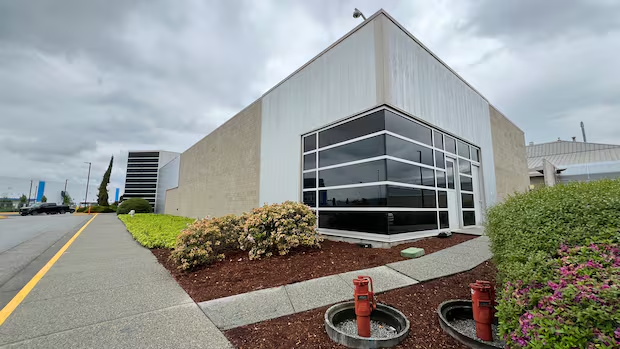
A jail that has held the likes of serial killer Robert Pickton, war criminals and Canada’s most notorious gangsters awaiting trials in its segregation cells is in an internal spiral.
The 300-cell North Fraser Pretrial Centre (NFPC) in Port Coquitlam, B.C., is embroiled in an unprecedented crisis of confidence amongst correctional officers who spoke to CBC News, as criminal charges levelled against a former colleague have reignited warnings about security lapses.
There has been a shadow at the pretrial centre ever since July 21, 2022, when gang murderer Rabih Alkhalil, 38, escaped the high-security facility, sparking an ongoing Combined Special Forces Unit investigation into who may have helped him.
Former correctional officer Naila Sheikh was Alkhalil’s case manager at the time of his escape in 2022. On May 28, 2026 she was charged with breach of trust, personation and unauthorized computer use. It is unclear if her recent charges are related to that incident.
Current and former staff say the facility is vulnerable to security breaches and prisoner escapes. They describe a culture of “organized madness,” where systemic issues have created an environment where misconduct thrives and alarms are silenced.
Staff say overflow from a shuttered Vancouver remand centre put pressure to hire more guards, and standards lapsed. Some new hires did not last.
“There’s been numerous times they’ve had to walk a lot of staff off the premises, so the question is: What’s their criteria?” said Levan Francis, a former correctional officer.
 Former B.C. Correctional officer Levan Francis is pictured in Delta, B.C., in August 2020. (Ben Nelms/CBC)
A bigger problem is the unfair promotions and lack of support when staff complain, he told CBC News.
“No one really wants to work in that environment,” said Francis, who won a landmark discrimination case at the Human Right Tribunal against the B.C. government after he faced racism and a “poisoned” work environment at the pretrial centre.
“There’s a stain now.”
B.C. Public Safety Minister Nina Krieger told CBC in an emailed statement that B.C. Corrections maintains rigorous hiring standards and ethical expectations and dismisses officers who don’t meet them.
“Ensuring the integrity of our correctional system is of paramount importance.”
Rumours swirl around 2022 escape
Two men from Ontario and one from B.C. were eventually charged with aiding Alkhalil’s escape.
Ottawa’s Edward Ayoub, 48, and John Potvin, 49, and Ryan van Gool, 46, from Harrison Hot Springs, B.C., are facing direct indictment with conspiracy to commit prison breach and prison breach.
None were prison staff. Sources told CBC that they wondered how a team of outsiders was able to smuggle in the plasma torches used to free him and walk out. Two of them posed as contractors, with video showing they left with Alkhalil, decked out in a hardhat and construction vest.
Alkhalil was arrested in Qatar in 2025 after three years on the run on Canada’s most wanted list.
 RCMP deputy commissioner Dwayne McDonald stands next to a wanted poster for Rabih Alkhalil in the days after Alkhalil’s escape from custody. (Ben Nelms/CBC)
He was charged along with Hell’s Angel Larry Amero and Dean Wiwchar in a 2012 gang murder.
His brazen escape prompted Surrey pretrial guards to take a closer look at his other co-accused, Wiwchar — and that was how they discovered damaged windows and a hacksaw hidden in his cell.
Before Alkhalil’s recapture, the convicted murderer told the sentencing judge that he “felt like the soldier left behind.”
“I still crack a smile at the thought of my co-accused embracing his freedom.”
Rumours have long swirled over how the vetting and promotions of newer hires may have played into the breach. Multiple current and former staff told CBC News that they had raised concerns during a separate, internal investigation about potential security lapses.
 Naila Sheikh, a former Port Coquitlam correctional officer, is facing three charges including breach of trust, impersonation and unauthorized use of a government computer. (Naila Sheikh/Facebook)
Others say they noticed them, but didn’t file formal complaints, fearing reprisal and a general lack of management support.
B.C.’s Public Safety Ministry said it has reviewed the facility’s security since the incident.
Sheikh turned herself in on June 29, a month after a warrant was issued for her arrest. She was released on conditions and is next scheduled to appear in Port Coquitlam court on Aug. 20.
Sheikh, who did not respond to CBC News’ requests for comment, is the second staff member — after Ramandeep Rai in October 2025 — charged in the last year for breach of trust related to an inappropriate relationship with an inmate.
The charges against the former officers are “deeply concerning,” said Krieger, though she noted that most of the 1,300 provincial officers serve with integrity.
Meanwhile, Alkhalil wasn’t the first to escape from the B.C. facility.
In 2007, an Iranian gang kingpin named Omid Tahvili fled after bribing a security guard to give him a janitor’s uniform and lead him out the prison doors. The guard was sentenced to three years in jail, but Tahvili was never recaptured. The year after, prisoner Dean Sykes posed as another inmate who was scheduled to be released and walked out a free man. Sykes was later arrested in Hope, B.C.
“In both these cases, we need to consider the fact that there was the human element involved,” the provincial solicitor general said after the second escape.
The B.C. government implemented five recommendations made in a report after an internal investigation, but declined to provide CBC News with a copy of it, citing privacy laws.
Red flags ignored
Staffers at the pretrial centre told CBC News they believe the 2022 escape could have been foreseen and that key security issues were ignored.
They pointed to specific failings, such as a malfunctioning security camera, despite several requests for a fix. Several described how the escape was facilitated by what’s believed to have been a strategically timed alert that developed into a rare “code yellow.”
Usually indicating a lockdown due to a security issue, the alarm pulled staff away from the isolation area where Alkhalil was held during a vulnerable time at shift change.
At least two correctional officers told CBC that they reported concerns to management, citing instances where inmate doors were left unlocked or staff were observed having long conversations with high-profile gangsters. It’s unclear how management followed up.
 Video footage shows Alkhalil in a black jumpsuit and high-visibility vest as he escaped. (Port Coquitlam RCMP)
Compounding these failures was the troubling discovery of contraband, including iPhones, drugs, and syringes, found in isolation cells in which Akhalil was held before the escape and during the COVID-19 pandemic when visitors were shut out, according to correctional officers and witnesses.
Retired 20-year career correctional officer Andrew Materi described his former workplace as “organized madness.”
“They know better, but they don’t want to change things.”
Materi described how staff who do complain face blowback, sometimes finding a slice of cheese stapled to their paystub, indicating they were now seen as a “rat.”
Inmates will pay “top dollar” for phones to help them run their businesses from the inside, and some staff are tempted, he said.
“You have a staff member who only makes $75,000 a year, but you have an organized crime member who’s worth millions of dollars.”
Officers still working at the centre say contraband found in the cells that housed Alkhalil and Amero in the months before the 2022 escape was seized, but say evidence in a manager’s safe was tampered with, so no charges were laid.
 Retired 20-year career correctional officer Andrew Materi described his former workplace as ‘organized madness.’ (Shawn Foss/CBC)
“It [raises] the question of corruption and who’s bringing it in? Especially in living units with high-profile inmates that have financial means,” Materi said. “It’s a red flag. You know something’s going on.”
He noted that serial killer Robert Pickton’s old cell was specially equipped for high-profile suspects. But Amero and Alkhalil were housed in a unit the floor below it at the time of the latter’s escape in 2022.
“The paradox is that the isolation unit holding the most dangerous inmates is the least secure area of the building, as it has the least number of doors to pass through to escape,” said Materi, who was often positioned in central control as one of the “pilots” of the building.
Now, with new, stricter bail reform legislation on the horizon, many fear more inmates will flow into the doors, adding more stress to the North Fraser Pretrial Centre.
The security lapses have made officers uneasy and less trusting of each other, Materi said.
“There’s been cases where I’ve seen staff members who do not get along say, ‘If there’s a code yellow on your unit, I’m going to take my sweet time,’” he said.
“Now, of course, prove they said that. Prove it.”