
Listen to this article
Estimated 5 minutes
The audio version of this article is generated by AI-based technology. Mispronunciations can occur. We are working with our partners to continually review and improve the results.
A First Nation in Manitoba’s flood-stricken Parkland area has declared a state of emergency due to washed out infrastructure that officials say has severed the community’s access to essential services.
Minegoziibe Anishinabe, also known as Pine Creek First Nation, joins a growing list of dozens of communities in the region to do so due to widespread flooding and damage.
Overland flooding has cut off access to regional centres with emergency services to the south, the First Nation’s chief and council told community members in a letter posted to Facebook through its health centre’s account Wednesday night.
The community, about 320 kilometres northwest of Winnipeg, sits on the western shore of Lake Winnipegosis and is connected to the town of Camperville by Highway 20, which is closed due to flooding. That highway also connects the First Nation to Dauphin, the region’s closest major centre.
Along with road closures to the west, toward Swan River, the community has been left in a “precarious position,” Chief Derek Nepinak wrote in the letter.
“We are landlocked in place without reliable road access,” Nepinak wrote.
The community planned to open a drop-in emergency centre at its community hall, which has backup power in case of an outage, as of noon Thursday, the notice said.
Evacuations are not currently being looked at, but that could change based on any “escalation of the weather crisis,” said Nepinak.
More than 30 communities in the Parkland region have now declared states of emergency. Travel is significantly restricted, the province said Wednesday, with transportation officials reporting up to 50 roads damaged, covered by water or with washed out sections.
Swan River situation ‘quite bleak’
Parts of the town of Swan River are under a mandatory evacuation order and highway access is cut off. That means fuel and food may need to be airlifted in to the town’s more than 5,000 residents, Mayor Lance Jacobson said Thursday.
“It’s quite bleak, actually,” he said of the overall situation.
Since a severe weather system brought thunderstorms to the area Monday night, “the rain hasn’t stopped,” he said, adding to problems the community was already dealing with after major flooding in early June.
“In my lifetime … we’ve never seen this amount of water that moved onto the Swan River,” said Jacobson, estimating the river’s level has risen about three metres above normal.
Jacobson said he surveyed damage Wednesday and spent time with community members, some of whom have lost their homes.
“It just tears you apart to see the damage that this river can do,” he said. “I could never imagine that this would have ever happened. It’s horrible, and it’s going to take some time to rebuild.”
The town’s drinking water system has so far held up to the stress, Jacobson said, as have its wastewater infrastructure and bridges. But roads and highways outside the community are washed out, and provincial transport officials will have to build them up again, he said.
WATCH | Flooding back ‘with vengeance’ in Swan Valley:
Flooding returns ‘with vengeance’ in waterlogged Swan Valley region
The same weather system that brought thunderstorms Monday night dropped more rain in western Manitoba on Tuesday. Some communities in the Parkland area still recovering from overland flooding only three weeks ago are once again battling rising water.
The mayor was due to meet with Premier Wab Kinew Thursday afternoon in Swan River. He has asked the province for 100,000 sandbags as well as water pumps.
“I wouldn’t mind seeing him convincing the federal government to bring us some military support, because I think we’re going to need it.… This is going to be a lot of work,” said Jacobson.
Volunteers who have been sandbagging to protect homes are “burned out,” he said.
“They’ve been doing this for a month already, and we’re tired and we need help.… It’s time for the federal government to listen to our call.”
Military help requested: Kinew
Kinew told CBC in a Thursday morning interview he’d been in touch with federal Emergency Management Minister Eleanor Olszewski, and spoke of the need to offer respite for provincial emergency workers and volunteers.
The province has also requested military assistance, Kinew said.
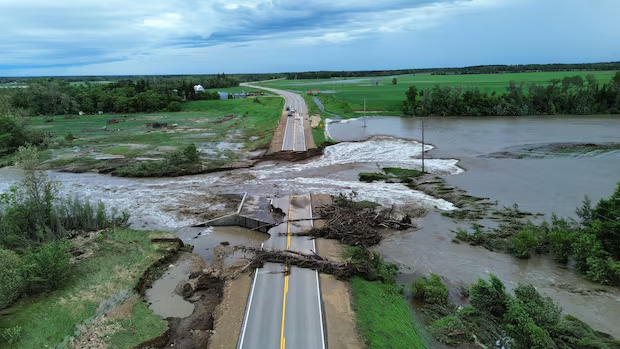
 An aerial view shows flooding near the community of Argyle, northwest of Winnipeg, on Thursday. (Rudi Pawlychyn/CBC)
Jacobson thanked those who have stepped up to help.
“We’ll get through this. It’s tough right now, and there’s a lot of rebuilding that will happen,” he said. “It’ll get done — but it’ll just take some time.”
An evacuation centre has been set up at the town’s Veterans Community Hall. Evacuees are asked to report there so the town can assess the immediate needs. Food and temporary support are also available at the centre, while potential longer-term accommodations are still being determined.
Evacuees who have a place to stay and don’t need help are still asked to notify the evacuation centre by showing up in person, or texting 204-281-0374 or 204-281-3343 with their name, home address, and the number of people who evacuated from that address, town officials said.