
Listen to this article
Estimated 3 minutes
The audio version of this article is generated by AI-based technology. Mispronunciations can occur. We are working with our partners to continually review and improve the results.
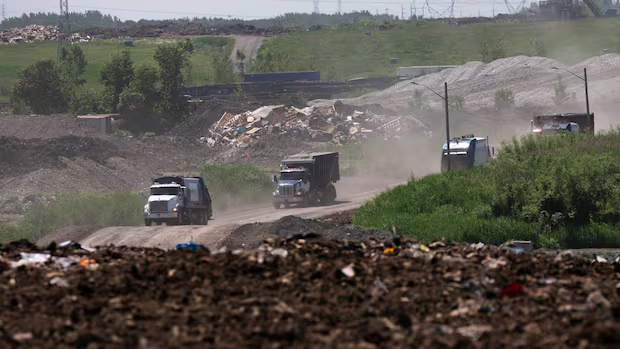
The Quebec government has authorized the temporary expansion of the province’s largest landfill in Terrebonne, which is expected to reach its maximum capacity in less than a year.
The decree was published in the province’s Official Gazette on Tuesday. Citing the looming shortage of capacity, the vertical expasion won’t require an environmental impact assessment and review process.
The change will allow the landfill’s operator, Complexe Enviro Connexions, to take in an additional 1.2 million tonnes of waste without enlarging its physical footprint.
The landfill north of Montreal is the largest site of its kind in the province.
It is also the only one located within the territory of the Montreal Metropolitan Community, known by its French initialism, the CMM. Roughly 30 per cent of the waste from the city ends up at the site.
City behind on waste reduction goals
The Terrebonne site takes in household garbage, bulky items, construction materials and industrial waste, alongside recyclable and organic materials. In addition to the landfill, the complex includes a biomethane production plant, a sorting centre and a composting facility.
Maxime Doyon, a spokesperson for the company, told Radio-Canada on Tuesday that preparatory development work for the site’s vertical expansion had already begun.
“This is a transitional and temporary measure which, environmentally speaking, remains subject to the same existing obligations, particularly regarding bio-gas management, odour control, leachate treatment and avian fauna monitoring,” he told Radio-Canada in an email.
The allowance will be in effect for 12 months starting in October 2026.
According to the City of Montreal’s own figures, the city remains far behind on its waste reduction goals.
Data from 2024 shows the city diverts just 49 per cent of its waste from landfills. That falls well short of its target to reach a 70 per cent diversion rate by 2025, and an 85 per cent rate by 2030.
While the city noted a seven per cent drop in the overall volume of waste generated per capita between 2020 and 2024, organic matter still makes up a major portion of what residents throw in the garbage.
Major expansion under review
The emergency decree comes as the operator is trying to permanently expand in size — a massive project aimed at extending the site’s lifespan until 2043. But the environmental review for that project remains ongoing.
According to the decree, a situation where waste had to be turned away from Terrebonne would cause major problems across the Montreal Metropolitan Community and beyond.
Karel Ménard, executive director of the Quebec Common Front for Ecological Waste Management, said the emergency decree is another sign the province isn’t properly dealing with its garbage.
“We are not capable of planning disposal correctly. We always rely on what the developer proposes to us. And when it’s full, they come knocking on the door saying: ‘I want an emergency decree.’ Unfortunately, that’s how it is,” he told Radio-Canada. “We always wait until the last minute.”
Quebec’s Environment Ministry confirmed the temporary expansion of the landfill will bypass the environmental impact assessment and review procedure, saying the required timelines are incompatible with the urgency of the situation.
WATCH | How we’re doing when it comes to composting:
Are Montrealers actually using their compost bins?
By the end of 2025, all Montrealers will have a brown bin for compost. But according to a 2024 survey, only about half of the city’s population is using them, and even fewer know what can go in the bins.