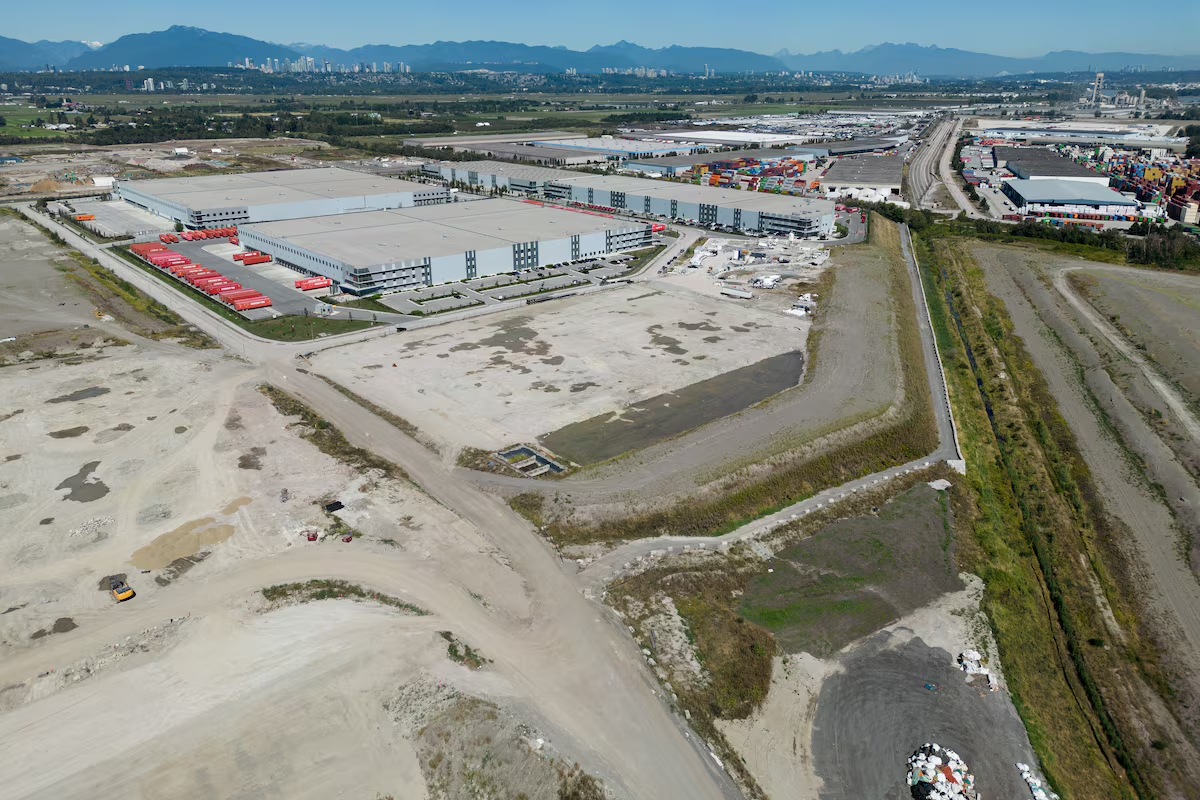

Open this photo in gallery:
Industrial lands that fall within the boundaries of a Cowichan Nation Aboriginal title claim, in Richmond, B.C., in August, 2025.DARRYL DYCK/The Canadian Press
A B.C. Supreme Court judge has dismissed an application by private owners of a swath of industrial land near Vancouver to reopen a lengthy court case that has thrown the legal status of their property into question.
In a decision released Monday, B.C. Supreme Court Justice Barbara Young said Richmond-based Montrose Property Holdings Ltd. is seeking to re-examine issues in the Cowichan Tribes’ landmark Aboriginal title case that have already been settled. She dismissed the application as an abuse of process.
“Allowing a new party to relitigate these issues, before this court, nearly two years after the conclusion of a 513-day trial, improperly interferes with the principal of finality,” Justice Young wrote in a 34-page judgement. “It is in the interests of the public and the parties that the decision at trial is final.”
Justice Young agreed with lawyers for the Cowichan Tribes who argued that allowing the application “could open the floodgates for numerous other private landowners and persons with commercial or other interests” to join the litigation.
The proper forum for challenging the ruling is through an appeal, which is already under way, she said.
Lawyers for the Cowichan argue case should not be reopened to consider private property rights
Ken Low, president and chief executive officer of Montrose Properties, said the company is considering its options.
“We will review the decision carefully and decide our next steps as there are a few legal options to consider,” he said in a statement Monday. “But we are not done, and private property rights must be protected.”
The Cowichan Tribes’ land claim trial concluded in November, 2023, after what was described as the longest trial in Canadian history. The final reasons for judgment were delivered in August, 2025.
The finding that the Cowichan had established Aboriginal title to a portion of their claim – their traditional summer village of Tl’uqtinus on the south arm of the Fraser River, now part of the City of Richmond – sparked business uncertainty and political outcry.
In a pretrial order, the court rejected an application from the federal government to serve notice to third parties in the Cowichan case. Then, in her final reasons for judgment, Justice Young ruled that the court has jurisdiction to make a declaration of Aboriginal title on the private lands in Richmond even without the private landowners present.
Montrose Properties is the largest single landowner in the title area, with holdings including a Coca-Cola bottling plant and a Canadian Tire depot. It sought to reopen the trial and join the action to make submissions on several issues, including whether it’s appropriate for a court to make findings of Aboriginal title over private land when the landowners were not part of the trial.
Boundaries of the land included in Cowichan title ruling are ambiguous, lawyers warn
Lawyers for the Cowichan argued that the application was an abuse of process and that reopening the case would undermine years of litigation. It would also give third parties an incentive to wait to join litigation, depending on the outcome after a trial, they said.
Justice Young said the issues raised by Montrose Properties had already been addressed and decided.
“While Montrose did not participate in the trial, the fact is these issues have been fully canvassed over the course of a lengthy trial by well-resourced parties,” she said.
Montrose Properties has 30 days to determine whether it will appeal Monday’s decision. It can also apply to intervene in the B.C. Court of Appeal proceedings, where all parties from the original trial have filed notices of appeal.
The Cowichan have repeatedly stated that the action is about B.C. and Canada taking responsibility for the historical, unlawful taking of Indigenous lands, and that they are not seeking to invalidate the land titles held by private landowners.
Clarity in the law of Aboriginal title is not optional
Reserve lands were set aside for the Cowichan in the 1850s by a colonial governor in what is now southeast Richmond, on the Fraser River. But after B.C. joined Confederation in 1871, the Crown began selling the land without legal authority. Richard Moody, the Crown agent who was tasked with ensuring that the reserves were created, made the first purchase.
David Rosenberg, lead lawyer for the Cowichan, said he was pleased with the decision.
“For 150 years, the Cowichan Nation have tried to redress the wrongful taking of their ancient village on the Fraser River,” he said in an interview Monday.
“At long last, the trial has concluded, and the hard work of reconciliation can continue and get under way seriously. This means the return of government lands, and it also means the Province of British Columbia will have to negotiate with the Cowichan about the private lands.”
Mr. Rosenberg noted that Justice Young reiterated the final reasons in her August decision, as well as those of B.C. Supreme Court Justice Jennifer Power’s 2017 ruling in Cowichan Tribes v. Canada, that both said providing formal notice to private landowners was not required.
“Procedurally, I think we now have a clear decision that in British Columbia, private parties have no place in this kind of litigation,” he said.