
Open this photo in gallery:
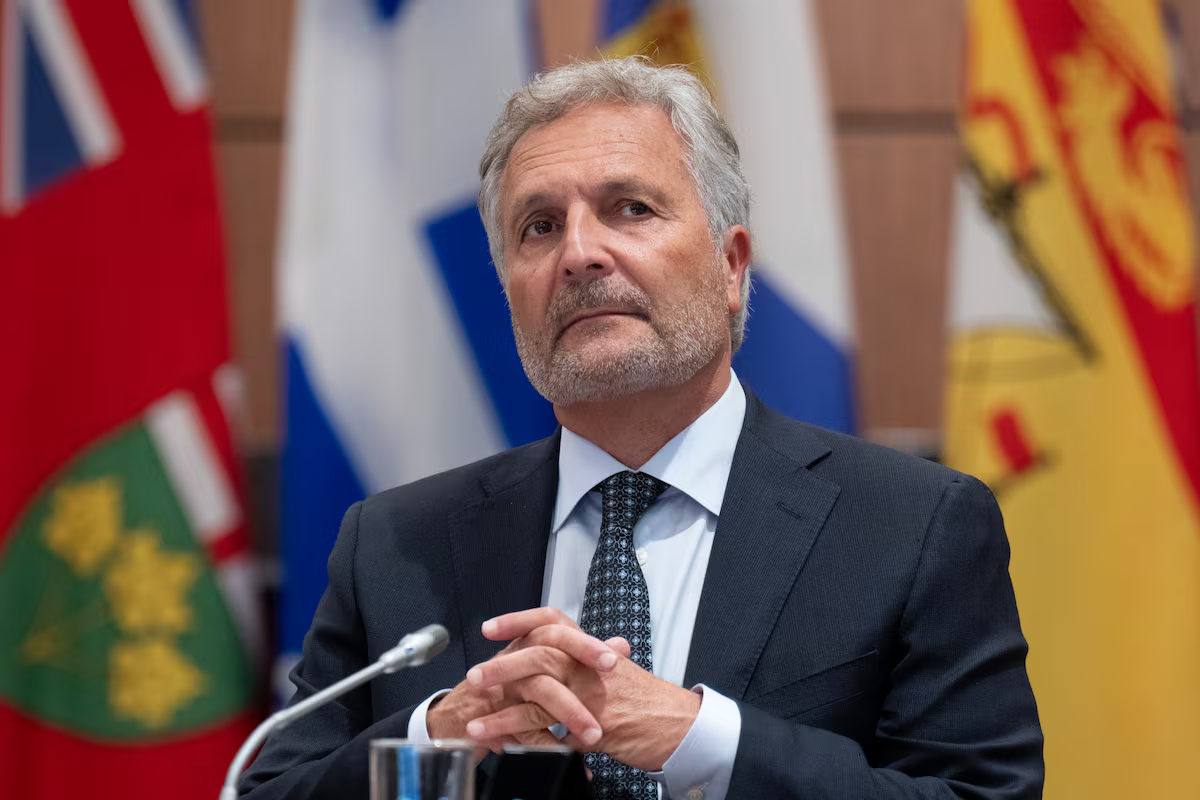
Supreme Court Justice nominee Glenn Joyal waits to begin a question-and-answer session with MPs and senators in Ottawa on Monday.Adrian Wyld/The Canadian Press
Glenn Joyal, the soon-to-be newest judge on the Supreme Court of Canada, on Monday told MPs and senators he is a “proud institutionalist,” has a Prairie sensibility that is practical yet creative and, as a long-time Winnipegger, he is reasonably useful in a snowstorm.
A week ago, Prime Minister Mark Carney named Chief Justice Joyal of the Court of King’s Bench of Manitoba to Canada’s apex court. The appointment becomes official soon, likely on Tuesday. Mr. Carney has sole discretion on the choice.
On Monday at a semi-formal meeting on Parliament Hill, conducted outside normal parliamentary privilege, MPs and senators asked questions of Chief Justice Joyal. This is part of a process of Supreme Court appointments Ottawa started a decade ago.
The rules dictated that queries could not broach issues such as legal or legislative debates.
Larry Brock, Conservative justice critic, tried to ask a strong question regardless. He asserted public confidence in the criminal justice system is at an all-time low, with the rise in violent crime since the mid-2010s. He asked Chief Justice Joyal about mandatory minimum sentences, a recent Supreme Court ruling that involved that issue and whether the federal government’s new legislative changes in Bill C-16 to restore some minimum sentences fell short.
The moderator, University of Ottawa associate professor of law Anne Lévesque, briefly interjected on “a few aspects of the question” but Chief Justice Joyal offered his answer, with some detail.
“The Supreme Court of Canada has never said you can’t have mandatory minimum sentences,” Chief Justice Joyal said.
He went on to say that mandatory minimums must be constitutionally compliant – meaning that they do not violate the prohibition against cruel and unusual punishment in Section 12 of the Charter of Rights and Freedoms.
Judges, he said, must be allowed discretion in exceptional cases where a mandatory minimum may be, as it is described in the courts, “grossly disproportionate.”
How Bailey’s Law and Bill C-16 target intimate partner violence and avoid overlap
Bill C-16, tabled last December, became law in mid-June. It restores some minimums struck down by the Supreme Court in recent years and provides judges with what the top court has previously called a safety valve – a window of judicial discretion.
Chief Justice Joyal, 66, arrives on the Supreme Court as a moderate.
He has been at the fore of Indigenous legal issues and, on Monday, spoke of continuing discussions in the legal community of a “tri-jural” system: English common law, French civil law and Indigenous legal traditions, from three founding peoples.
In 2017, he gave a speech at a Canadian Constitution Foundation conference viewed as somewhat conservative. Chief Justice Joyal’s speech looked at the Charter of Rights and the balance between judges and elected politicians, and argued there had been “an increasing judicial dominance in that judicial/legislative institutional relationship.”
On Monday, Liberal MP Anthony Housefather asked Chief Justice Joyal about his “judicial ideology.”
The judge evoked a foundational metaphor of jurisprudence in this country: “I believe in the living tree.”
This means the law, and judges, evolve with society and the times. Critics argue some judges push this philosophy too far, edging into territory that belongs to Parliament and legislatures.
Chief Justice Joyal said a judge’s analysis of laws and the Constitution includes the text, context and purpose of the words on paper. Depending on the case, he said judges have room for “a degree of restraint – or not.”
“The idea that one has to define oneself with this rigid ideology, if that’s what it is, with respect to interpretive approaches, I just don’t think that that’s necessary here,” he said.
A seat on the Supreme Court opened in mid-January, when highly regarded Justice Sheilah Martin, from Calgary, announced her retirement date of May 30.
There were only nine applications for the job, said Maureen McTeer, chair of an advisory board on the Supreme Court opening that reports to Mr. Carney.
“It seemed low to me,” Ms. McTeer said earlier on Monday at the House of Commons justice committee.
Open this photo in gallery:
Maureen McTeer, left, attends Chief Justice Joyal’s question-and-answer session alongside her husband, former prime minister Joe Clark.Adrian Wyld/The Canadian Press
The board interviewed four people and recommended two to the Prime Minister.
The board is supposed to offer at least three names but just as in the last appointment from Western Canada, in 2023, it was only two. Some critics say the requirement of “functional” bilingualism, started in 2016, reduces the list of strong candidates from Western Canada.
Peter Sankoff, a veteran criminal defence lawyer in Edmonton, noted the unusual fact that Chief Justice Joyal is the third consecutive Supreme Court judge from the superior courts, where big trials happen. The new judge follows Justice Mary Moreau in 2023 and Justice Michelle O’Bonsawin in 2022.
For decades, most judges of the top court had served on appellate courts. A few appointments were star lawyers. Mr. Sankoff noted appellate work is more in line with the work of the Supreme Court than that of trial courts.
Mr. Sankoff didn’t question Chief Justice Joyal’s bona fides – he has been a judge for nearly three decades – but said of trial-court judges jumping to the Supreme Court: “For 70 years, those appointments didn’t happen.”
Jamie Cameron, professor emerita at York University’s Osgoode Hall Law School, met Chief Justice Joyal once, two years ago. After he gave a talk, he introduced himself and asked in detail about work she had published on the Charter’s freedom of expression. The encounter impressed her.
“He may be more conservative as a judge than I would prefer but he strikes me as a very rigorous person, alert to difficult issues,” she said. “He’s as ready as anyone could be to step on to the bench of the Supreme Court.”