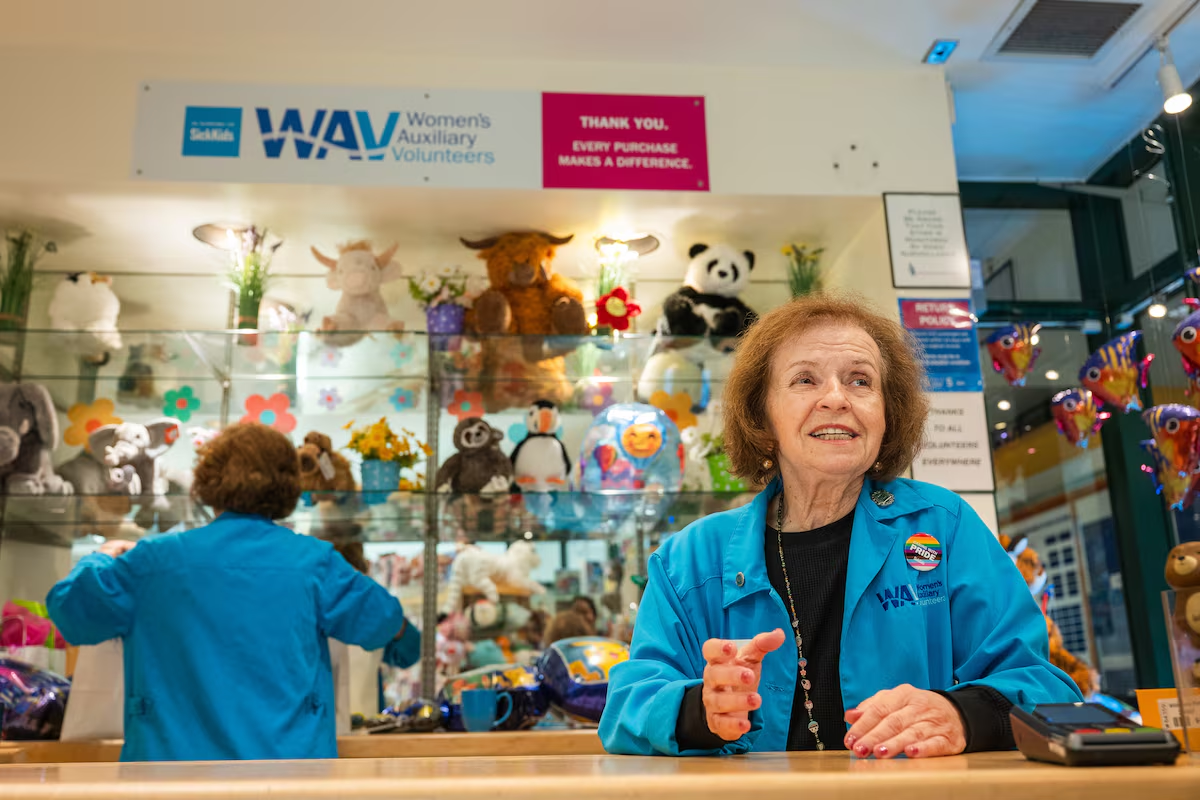
This is the first in our summer series Care Between the Lines, which will introduce you to volunteers in health care who fill gaps and provide compassion in a system that can be isolating and scary.
Lydia Canning was seven years old when she was diagnosed with a rare blood disorder that sent her to the hospital for weeks at a time.
Now 76, she only has scraps of memories from that chapter of her childhood. The streetcar ride to Toronto’s Hospital for Sick Children. The bags of ice piled on her bed when she spiked a fever. Her siblings waving from the lawn outside the hospital, where her parents were only permitted to visit twice a week.
But what she remembers most vividly are the “play ladies” who brought her fun distractions; a basket to weave, a Bugs Bunny craft. Seven decades later, those playful moments are the ones that remain imprinted in her mind – not the needles, surgeries or long, lonely nights. “Those memories have faded,” she says. “And the good memories have come to the forefront.”
Open this photo in gallery:
Lydia Canning, president of the Women’s Auxiliary Volunteers (WAV) at SickKids. Ms. Canning, 76, was once a patient herself at the hospital, and has many good memories of WAV members and the care they provided.
The people responsible for those crafts weren’t nurses, doctors or anybody paid to be there. They were members of the Women’s Auxiliary Volunteers, SickKids’ oldest and most well-known volunteer group, of which Ms. Canning was recently appointed president.
Volunteers are a powerful and under-appreciated engine of Canadian healthcare. As a healthcare workforce, they operate in parallel to the medical staff and other workers on payroll, often tending to the emotional and human concerns of patients and their families.
But it’s a workforce that may be coming under strain. According to latest data from Statistics Canada, volunteering rates dipped by 8 per cent between 2013 and 2018, and declines were particularly acute in the hospital sector, which saw volunteer hours plunge by 47 per cent.
But despite this precipitous drop, Canadians still spent 35 million hours formally giving their time to hospitals in 2023. Such unpaid work is a boon for a chronically cash-strapped healthcare system, filling gaps everywhere from the bedside to research labs and administrative offices. According to a 2004 study that analyzed 31 Toronto-area hospitals, every dollar invested in the infrastructure required to administer volunteers translated to $6.84 in value on average – a return on investment of nearly 700 per cent.
The impact volunteers can have on patients and their families is harder to measure. While volunteers don’t provide medical care, they typically give care of a different sort; a human touch, a shoulder of support, or some kind of extra boost that can make all the difference. Like, for instance, a Bugs Bunny craft.
“In my research, we talk about creating the healthcare systems that people expect, but may not encounter,” says Michelle Nelson, a senior investigator with the Bruyère Health Research Institute and University of Ottawa professor, who studies volunteers in healthcare.
“But when you see volunteers in the hospital, they’re often serving as the intermediary or connective component of creating the warm, caring, sophisticated healing systems that we’ve come to expect,” she says.
Photos from The Globe and Mail and Hospital for Sick Children archives capture the early years of the Women’s Auxiliary Volunteers. Founded in 1950, WAV remains a women’s-only entity, in part because they see their sisterhood as integral to the culture of the group. John Boyd/The Globe and Mail; Hospital Archives/The Hospital for Sick Children, Toronto
Women’s auxiliaries are the original hospital volunteers, dating back to 1865 in Canada, when the country’s first hospital auxiliary was formed in St. Catharines, Ont.
As Canada’s oldest and most storied pediatric hospital, SickKids owes its very existence to women volunteers. The hospital was founded in 1875 by a “Ladies Committee,” which rented a two-storey row house where they volunteered as self-taught nurses and a rotating cast of “consulting medical officers” dropped in to treat patients. The hospital’s Women’s Auxiliary was formed 75 years later, shortly before the hospital moved into its current location in 1951.
Open this photo in gallery:
Dr. Helen Reid Chute speaks at the WAV’s 50th anniversary celebration in 2000. Dr. Chute was a key figure in founding the WAV.Hospital Archives/The Hospital for Sick Children, Toronto
According to SickKids’ lore documented in a staff newsletter, the idea for the auxiliary emerged during some “pillow talk” between two doctors. SickKids physician Andrew Lawrence Chute was struggling to find the $2,000 needed for a medical library in the new hospital building. He suggested to his wife and fellow physician, Helen Reid Chute, that she organize some women to raise the money, according to the newsletter.
They did so and more, holding a “bazaar” at Casa Loma that brought in more than $4,700 (about $65,000 in 2026 dollars). That was enough to fund not only the new library, but the formation of a powerful new fundraising group that in the last three decades alone has raised more than $23-million for SickKids and funded five endowed research chairs.
As a volunteer organization, the auxiliary has grown to fulfill an ever-expanding list of services requested by the hospital. Today, their bright turquoise jackets can be spotted all over the hospital – in the basement, where sewists gather weekly to make surgeons’ caps or baby blankets; in the auxiliary-owned gift shop, which donates all proceeds to the hospital; or delivering carts of library books to the in-patient units.
“They’re just part of the fabric here,” says Karen Kinnear, vice-president of clinical operations and patient and family experience.
The auxiliary is still, for now, entirely made up by women. While they’ve been asked before to open their membership to all, the consensus decision has always been that the group’s sisterhood is a key component of its unique culture.
The auxiliary is membership based, charging an annual fee and requiring a minimum weekly commitment of three hours for at least one year. But active membership dropped in the early years of the COVID-19 pandemic, especially amongst retirees, who make up the bulk of volunteers.
Open this photo in gallery:Open this photo in gallery:
WAV member Josette Turnbull passes through the stockroom and enters the hospital’s sewing area, where fellow volunteer Priti Sachdeva is working on a quilt. SickKids’ WAV membership is steadily climbing back to pre-pandemic levels, with 220 active members.
This echoes a broader trend that seems to have played out across the country. Between 2018 and 2023, which includes the early pandemic years, volunteering hours were dramatically reduced not just in hospitals, but among women, whose average volunteer hours across all sectors dropped by 21 per cent. Declines among men, meanwhile, were not significant.
Researcher are now trying to understand this shifting landscape. “It’s important that we really think about the pandemic as a time that substantively restructured the way we, as people – but mostly the way we, as women – are spending our time. And it made shifting back to discretionary commitments harder,” Dr. Nelson says. “We’re seeing a snowballing of social forces, and we’re seeing it show up in volunteerism for women and we’re seeing it show up in volunteers in hospitals.”
But at SickKids’ Women’s Auxiliary, membership is steadily climbing back to pre-pandemic levels, with about 220 members currently active (there were 254 in 2019). One of them is Ms. Canning, the little girl who was healed by SickKids 70 years ago and grew up determined to some day give back.
In 1984, Ms. Canning found herself back at SickKids, this time as a parent, accompanying her daughter to a minor surgical procedure. As she was leaving the waiting room, she approached the volunteer behind the counter. “Where do I apply?” she asked. It was only later that Ms. Canning realized she had signed up for the Women’s Auxiliary, the same group that made her those crafts all those years ago.
In their bright turquoise jackets, WAV members can be spotted all over the hospital lending a helping hand to patients and their families as they navigate some of the most difficult moments of their lives.
Nowadays, Ms. Canning can be found volunteering every Thursday in the surgical waiting room, where she’s been posted for 35 years. Her day begins at 7:30 a.m., when she starts registering anxious parents, relatives or guardians in the waiting room; once their child is out of surgery, she escorts them to the recovery room or intensive care unit.
Unofficially, however, her job is to be something of a guardian angel. The auxiliary volunteers keep a caring eye on everyone – they have a time-tested system for identifying every parent by chair and clothing items. Once, Ms. Canning noticed a parent who wasn’t doing well, so she went to the cafeteria and bought her a muffin and orange juice; years later, the woman recognized her in the hallway and thanked her for that kindness.
The waiting room volunteers also understand parents’ primal need to be reunited with their child as soon as possible. Neurosurgeon James Rutka remembers the time he wrapped up a surgery much faster than expected, but the parents had left the waiting room and weren’t answering their phone. The auxiliary volunteer managed to track them down at the Tim Hortons downstairs.
Open this photo in gallery:
Volunteer Penny Westmacott organizes books in the hospital’s Family Centre and Children’s Library.
“They would go above and beyond their duties to make sure that the message from the surgeon is delivered to the families,” Dr. Rutka says. “They know that information is so important for them to hear.”
Like Ms. Canning, many auxiliary volunteers have a personal connection to SickKids. Inside the hospital’s family centre, which houses a children’s library, volunteer Rita Song was inspired by her six-year-old granddaughter to join the auxiliary.
Her granddaughter has been a patient at SickKids since she was two months old, undergoing several major operations. As a baby, she was very withdrawn, probably due to pain, Ms. Song says. But in the family centre, she smiled and became engaged for the very first time.
“This was her favourite place,” Ms. Song says. “So it just felt that it was appropriate to volunteer.”
In the hospital’s cancer clinic, where auxiliary volunteers are a fixture, many patients have come to know the women by name. “Where’s my hug?” volunteer Anita Allen exclaims on a recent Wednesday morning, when she spots a young patient, who smiles and leans into her embrace. He’s been coming here for about three years now, so Ms. Allen knows exactly what he likes, setting him up with some green Play-Doh and shape cutters.
The brightly-coloured waiting room is full of thoughtful touches; toys, video games, a snack cart. Outside the phlebotomy room, where kids often have to line up for bloodwork, a volunteer has taped colouring sheets to the wall, alongside crayons suspended by string.

The WAV run the ‘bravery bead’ program, which gives patients a bead to mark every procedure, milestone and treatment.
Open this photo in gallery:
Ms. Canning, who has been volunteering since 1984, was present at the launch of SickKids’ bravery beads program in May, 2002.Hospital Archives/The Hospital for Sick Children, Toronto
Ms. Allen spent her entire career at SickKids, where she worked for 30 years as a nurse. But after retirement, she left the hospital for about two months before boomeranging back as an auxiliary volunteer.
Now, she is no longer the one wielding needles or catheters; just toys, games and joy. “They don’t see it as a down,” she says of the patients. “They get to play; they get to see us.”
For 19-year-old Hugh Maw, who was diagnosed at age four with a brain tumour and was a SickKids patient for 13 years, the “bravery bead” program is what he appreciates most from the volunteers.
For every procedure, milestone or treatment, patients are given a specific bead to mark the occasion – an airplane if they were airlifted to the hospital, for example, or a dark purple bead if they had an amputation.
As a pediatric cancer patient, Hugh’s favourite bead was the one for radiation – it glows in the dark. He’s now collected 33 radiation beads, and amassed a total collection of more than 455 bravery beads.
Open this photo in gallery:
Hugh Maw wearing his ‘bravery beads,’ which represent the hundreds of procedures, tests and surgeries he’s endured as a patient.The Hospital for Sick Children, Toronto/Supplied
His final bead from the Women’s Auxiliary was likely a multicoloured sparkly one; the bead given to patients who graduate into adult care. Now that he’s in the adult hospital system, he misses the volunteers and the ambient comfort their presence provided. “The doctors and nurses are still amazing,” he says. “But without the Women’s Auxiliary there, it’s missing a certain warmth.”
His mother, Kate, feels this lack now, too. In her many years as a SickKids parent, the auxiliary volunteers were like stand-in grandmothers and aunties, often intuiting what she needed. After one of Hugh’s first surgeries, he was too unstable for his mother to stay at his bedside, but the auxiliary volunteer brought Ms. Maw to the recovery room several times, just so she could see he was okay.
Ms. Maw recalls buying a yellow garbage truck from the auxiliary’s gift shop early into her SickKids journey – a mother’s desperate bid at bribing her four-year-old son to lie still for his MRI, which took about an hour and a half. (To date, Hugh has had more than 60 MRIs, according to Ms. Maw.)
She remembers how gentle the volunteers were with her when she explained the purpose of that toy.
“They really met you where you were in that moment,” she says. “They’re really a safe space.”
But something Ms. Maw especially appreciates is how the auxiliary helped care for her daughter, her healthy child, when she was overwhelmed by Hugh’s medical needs.
The importance of that is something Ms. Canning can relate to. Back when she was a SickKids patient in the late 50s, her four-year-old brother and ten-year-old sister had to wait in the rotunda alone while her parents came for their hour-long visits. Nowadays, siblings can be dropped off in a bright and modern playroom run by the auxiliary, stocked with toys, art supplies and video games.
“Not having to arrange childcare, being able to give yourself a breath before you explain something like the chance of survival for your other child … it was just life saving,” Ms. Maw says.
Between the auxiliary volunteers and her own parents, who moved in to help with her daughter, it gave her profound comfort to know that her other child was cared for during this deeply stressful time. “I was being mum to Hugh, and a wife to my husband,” she says. “And the Women’s Auxiliary were there for me.”