
Welcome to our weekly newsletter where we highlight environmental trends and solutions that are moving us to a more sustainable world.
Hi, it’s Bridget! When walking home from work one day, I noticed a couple of electric FedEx delivery vans parked at the car dealership by my apartment. It made me want to look into other examples across Canada where small commercial vehicles are being electrified.
This week:
- Not just for golf courses: Electric carts are another EV option hitting the streets
- The Big Picture: Seismic lines
- Why wildflower mixes may do more harm than good
Not just for golf courses: Electric carts are another EV option hitting the streets
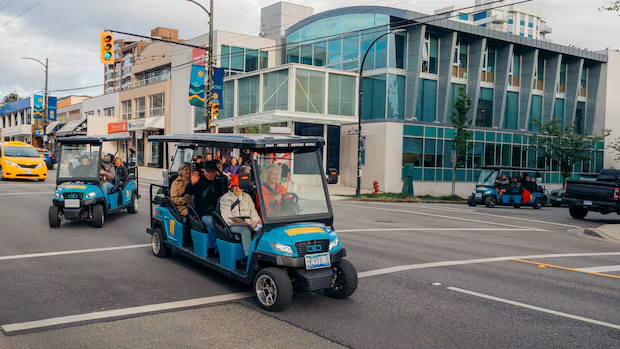
 HeyYa Carts rents street-legal electric golf carts to help people get around Vancouver and Victoria. (HeyYa Carts)
Tasha Maynard’s vision for B.C. is one with small, accessible electric vehicles. She hopes they will help create a sense of community, with less noise and pollution in downtown cores.
“I had a ‘what if’ moment of what would the world look like if we were able to make electric [carts] fun and accessible, and that was really where the idea of HeyYa Carts was born.”
Maynard founded the company in 2024. It rents street-legal electric golf carts to help people get around Vancouver and Victoria. Its fleet includes 35 vehicles, all manufactured in B.C.
The low-speed electric vehicles (LSVs) come in four-, six- and eight-seat models. They can travel up to 40 km/h and have a range of up to 80 kilometres.
An LSV, according to Canada’s Motor Vehicle Safety Regulations, is a vehicle primarily used on streets and roads, which travels on four wheels and up to 40 km/h.
“We use the HeyYa carts for the grocery store, dropping the kids at school, taking the dogs to the park — all those really short trips where you don’t necessarily need your bigger gas vehicle,” said Maynard. She believes that wider adoption of LSVs will contribute to cleaner air and safer roads for pedestrians and cyclists.
 HeyYa Carts being driven around downtown Vancouver. (HeyYa Carts)
HeyYa Carts has partnered with various events and festivals in the city, including the Vancouver Marathon, where its carts served as the lead vehicle. A truck had previously been used.
Maynard says children smile at her and pedestrians wave when she is in one of the carts. It is the kind of change she wants to see, instead of everyone getting in their cars, rolling up their windows and driving quickly.
“It’s the complete polar opposite. You’re slowing down, you’re more connected within your community and within the city.”
Maynard hopes LSVs will be more widely adopted in cities. She says another motivation of is sustainability — creating a clean planet and fresher air for her children.
A low-hanging alternative
Maynard isn’t the only one working to replace diesel- and gas-powered vehicles with small electric alternatives.
Cody Eaton, sales manager at Albion Golf Cars in Ontario, works with a variety of street-legal LSVs.
The company started in the 1970s as a golf-car dealership but has since expanded into commercial and consumer services, providing LSVs for campgrounds, trailer parks, cottages and hobby farms.
 Eaton drives an LSV to and from work. It takes an extra 10 mins compared with driving his car, but he says the LSV is a more enjoyable ride. (Albion Golf Cars)
Albion Golf Cars also works with commercial fleets, like Purolator, the cities of Toronto and Mississauga, campgrounds, airports, hospitals and university campuses.
“Campuses are kind of a big account for us,” he said. “A lot of them will use these types of vehicles in lieu of a truck or a diesel-powered piece of equipment.”
He cited the University of Guelph, the University of Toronto and York University as examples. The LSVs are used by maintenance and landscaping teams, as well as for shuttle transportation and parking management. They are also used for student services, such as campus tours.
Eaton said Ontario departments must report their carbon footprints, making LSVs a low-hanging alternative for those using trucks.
Bylaws and challenges
Eaton is optimistic LSVs will become more widely adopted, but says getting government approval and navigating bylaws that vary between municipalities remain a challenge.
“Toronto says they need to be plated to be driven on the road, but you go up Lake Huron along the beach communities and it says you [only] need headlights, turn signals and seatbelts,” he said.
In Moose Jaw, Sask., enclosed mobility scooters — LSVs used by many people with disabilities — are banned from both sidewalks and roads.
Eaton is hopeful a federal pilot project examining municipal bylaws governing LSV use will lead to more consistent federal regulations across Canada.
Small changes still make a difference
Bassam Javed is a professor at the Institute for Resources, Environment and Sustainability at the University of British Columbia. He has studied the growing popularity of LSVs in China.
He said LSVs are becoming more common for industries such as urban logistics and aviation because they are relatively inexpensive to buy and maintain. Albion’s electric carts start at $10,000.
Javed said their most immediate impact will be on air quality and noise, especially in busy places such as resorts.
“The type of vehicles that a low-speed electric vehicle could replace are a fairly small slice of the overall pie of transportation emissions,” he said. “But any little bit that we can do to reduce GHG emissions is helpful for climate action at the end of the day.”
— Bridget Stringer-Holden

Old issues of What on Earth? are here. The CBC News climate page is here.
Check out our podcast and radio show. In our latest episode: Cindy MacDougall calls herself a climate change casualty. If it hadn’t been for her husband’s quick action during the 2021 Western Canada heat dome, she might not have survived the disaster. Her heart was permanently damaged.
LISTEN | It’s been 5 years since the deadly heat dome. Are we any safer?:
What On Earth32:32 Five years after the deadly heat dome, are we any safer?
What On Earth drops new podcast episodes every Wednesday and Saturday. You can find them on your favourite podcast app or on demand at CBC Listen. The radio show airs Sundays at 11 a.m., 11:30 a.m. in Newfoundland and Labrador.
Check the CBC News Climate Dashboard for live updates on record-breaking weather and current conditions across the country. Set your location to find out how today’s temperatures compare to historical trends.

Reader feedback
Last week, we featured a story about young Canadians and environmental groups suing the federal government for allegedly violating Canada’s climate accountability legislation.
Frieda Adams wrote: “I’m in my 80s and, until recently, thought the current Canadian government had a desire to change the impact of climate change. I no longer think they are doing enough in the right direction. I realize you are unable to have everyone happy, but we are going backwards.
“I am with the younger generations that have to deal with the aftermath of bad decisions we have made and are still making today, by eliminating the carbon tax for one. By claiming by 2050 now instead of 2030 that’s 20 yrs when we are already seeing and feeling the effects.
“I will pray with all my heart for the group that has taken the initiative to sue the government. Members of government are being well paid by us to help the environment not turn their backs on the very small progress that has been made.”
Write us at whatonearth@cbc.ca (and send photos there too!)
The Big Picture: Seismic lines speed up methane emissions from peatland
 (Submitted by the University of Waterloo)
This long path has been cut through the boreal peatlands of northern Alberta by oil and gas companies moving surveying equipment. Such routes — known as seismic lines — criss-cross a wide swath of Canada’s oil producing regions and are increasingly being seen as an environmental problem.
Historically, companies were not required to restore the lines because they were expected to regrow on their own. But recent research has shown the sensitive, carbon-rich peatlands do not regenerate easily. Some lines have failed to regrow even 50 years later.
I wrote about a new study from University of Waterloo researchers that says these lines are also a significant climate problem. Damaged peatland along the lines could be emitting two to three times more methane than undamaged areas.
Methane is a potent greenhouse gas with about 80 times the heat-trapping power of carbon dioxide, so these unrestored seismic lines could be speeding up climate change.
That is adding urgency to efforts in Alberta and elsewhere to restore them.
—Inayat Singh
Hot and bothered: Provocative ideas from around the web
- A new bike lane built in Mexico City for the World Cup has led to protests from people who say it has negatively impacted their livelihoods: sex workers.
- The rise of GLP-1 medications could be doing what decades of environmental advocacy couldn’t: curbing the U.S. appetite for high-emission foods such as beef and refined carbohydrates.
‘Wildwashing’ in the garden: Why wildflower mixes may do more harm than good
 Tansy is among the plants not native to Manitoba that are often found in wildflower mixes, says a Winnipeg nursery owner. It’s among the plants on the province’s list of noxious weeds. (Anna Tosca/Shutterstock)
Generic wildflower seed mixes promise an easy way to help pollinators and ecosystems, but many may contain potentially harmful non-native species.
When CBC asked Diana Bizecki Robson, the Manitoba Museum’s curator of botany, to investigate seeds from a wildflower mix, she found just two of the 17 species were native to Manitoba. Another four were native to North America, while the rest were from Africa, Asia or Europe.
“They’re wild somewhere on planet Earth,” Bizecki Robson said. “But not necessarily here.”
Her concern isn’t just where the plants came from — it is what they could become.
“My first concern was, ‘Oh gee, I hope they didn’t put anything noxious in there’ — something that’s going to end up turning into a really invasive weed,” Bizecki Robson said in an interview Tuesday with CBC Manitoba’s Information Radio.
Manitoba regulates 90 noxious weeds — plants deemed a threat to agriculture, the environment or public health.
While none of the species Bizecki Robson reviewed were on Manitoba’s noxious weeds list, she said gardeners buying wildflower mixes should still be cautious.
Invasive species in Manitoba
Invasive plants spread aggressively and outcompete other species. They are always non-native, though not all non-native plants become invasive.
Ash Burkowski, owner of Northern Wildscapes Plants and Design, a home-based native plant nursery in Winnipeg, says certain wildflower species are getting out of control.
Some of the more prominent invasive species found in wildflower mixes include ox-eye daisy, tansy and baby’s breath — all of which are on the province’s list of noxious weeds. Burkowski says such invasive species are becoming a growing problem because some people are actively spreading them.
It’s “becoming a definite … ecosystem issue right now” for native prairie habitat, said Burkowski. She noted that less than one per cent of Manitoba’s native tall-grass prairie remains today.
“So, you know, these habitats getting invaded by various invasive species is really detrimental.”
Burkowski said avoiding problematic species in the first place is key because, once planted, their seeds can spread through wind, animals or human activity.
“Lots of people say, ‘Oh, I like it, it’s pretty, it’s not invasive in my yard,'” she said. “But birds eat the seeds. Seeds can spread on wind, they can spread on animals.”
While not every invasive species immediately causes problems, Marika Olynyk, a curator at the Living Prairie Museum — a prairie preserve in Winnipeg — warns that once established, they become extremely difficult to remove and can easily spread into new areas.
The consequences for both the environment and the economy can be significant.
According to the Canadian Food Inspection Agency, invasive plants in crops and pastures cost an estimated $2.2 billion annually because of crop production and quality losses, along with increased weed-control costs.
Wildflower ‘doesn’t actually mean anything’
Both Olynyk and Burkowski say the term “wildflower” has become misleading because it can refer to flowers from anywhere.
“[It] doesn’t actually mean anything,” said Olynyk. “I think the words people want to be looking for are ‘local’ or … ‘native prairie,’ that kind of stuff.”
Native plant species help support local ecosystems and pollinators. Bizecki Robson doesn’t want people to engage in what she calls “wildwashing” — similar to greenwashing, or making something seem more environmentally friendly than it is.
People often believe anything labelled a “wildflower” will be good for the environment, when that may not be true of a non-native species, she said.
Burkowski said she checks wildflower seed-mix packaging to see which flowers are included.
“There’s only been once where I picked it up and I went, ‘Yeah, this is OK’ … or there wasn’t something in there that wasn’t concerning.”
A 2022 assessment of 16 seed distributors by the Invasive Species Council of British Columbia found that each sold at least one invasive seed variety. The seeds were sold in individual packs or wildflower mixes, and few companies included warnings about invasive species.
Bizecki Robson said gardeners should take their time when buying seed mixes. She suggests taking a picture of the package, checking which species are included and finding out whether they are native to Manitoba.
For gardeners looking for a place to start, Burkowski suggests species such as milkweed, which support monarch butterflies — a popular focus for many gardeners.
— Trinity Kakegamic
Thanks for reading. We’ll be taking a break for Canada Day, and will be back on July 9. If you have questions, criticisms or story tips, please send them to whatonearth@cbc.ca.
What on Earth? comes straight to your inbox every Thursday.
Editor: Emily Chung | Logo design: Sködt McNalty