
Open this photo in gallery:
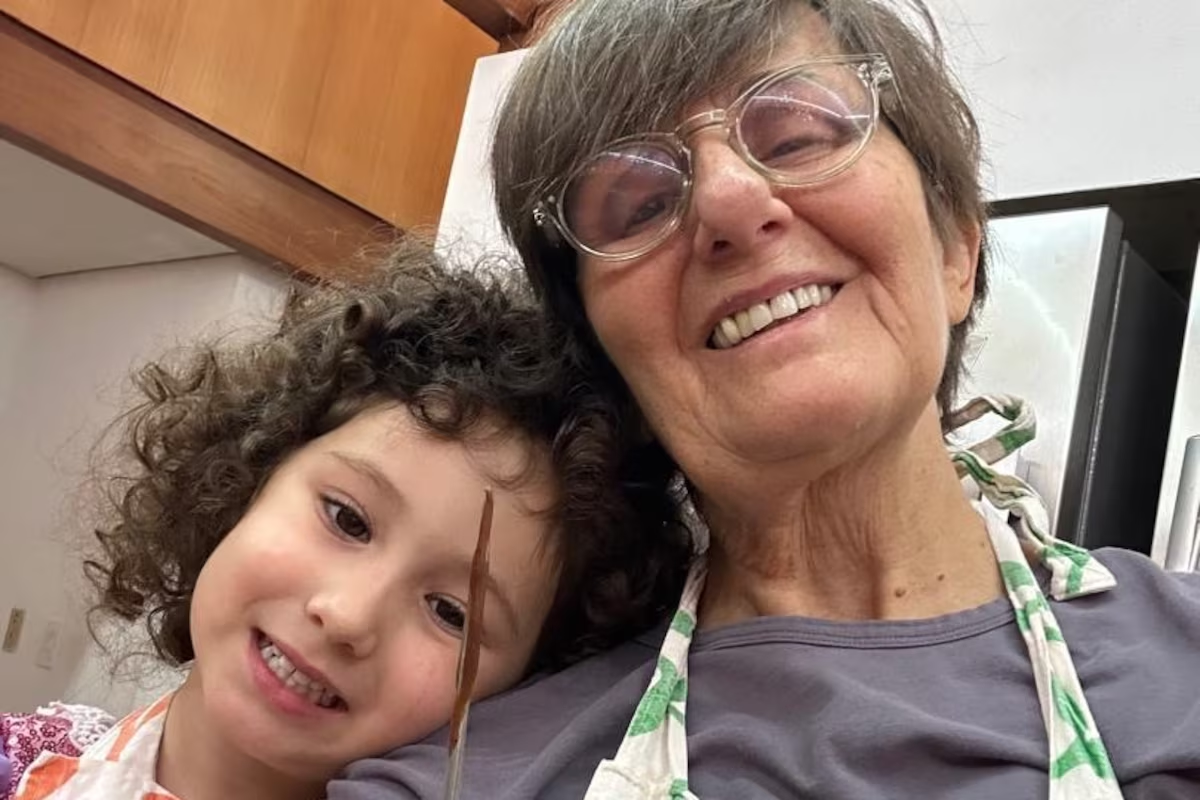
Lila Vega, a Canadian citizen and doctor in Caracas, is taking care of her granddaughter Isabella Quintero during the fallout of the earthquake.Courtesy of Lila Vega/Supplied
When Jesus Arzola picked up the phone Wednesday evening, the first words he heard on the other end of the line were “I’m sorry.”
When his friend told him about the powerful earthquakes that rocked Venezuela, Mr. Arzola was nervous for his family’s safety. He spent the night repeatedly calling his brothers and sisters to see if they were safe.
By morning, Mr. Arzola confirmed everyone in his family was alive except one of his sisters. He saw photos on social media showing that her apartment building had been levelled and he hasn’t been able to reach her.
“I saw the building where my one of my sisters live, which has collapsed. There’s nothing. It’s totally gone and very bad,” he said in a Thursday interview.
The 7.2- and 7.5-magnitude earthquakes that shook the country Wednesday evening are among some of the strongest to hit Venezuela in more than a century, closing its international airport north of the capital city of Caracas.
The earthquakes killed at least 188 people by Thursday evening and injured nearly 1,000, though many more were missing and those numbers were expected to increase.
A powerful 7.1-magnitude earthquake shook Venezuela on Wednesday evening, collapsing buildings in the capital of Caracas.
The Associated Press
The disaster has left Canadians with families in Venezuela worried about their relatives back home and anxious for news.
Some members of the Venezuelan diaspora in Canada said they are also worried that the natural disaster will further destabilize a nation already in political turmoil after the United States captured former Venezuelan president Nicolás Maduro in January. There were roughly 27,000 Venezuelan-born people living in Canada as of Statistics Canada’s 2021 census.
In an unattributed e-mail statement, Global Affairs Canada said it is “not aware of” any Canadian citizens affected by the earthquakes. There are currently 740 Canadians registered as being in Venezuela, according to department numbers.
Meriely Arias, who was born in Venezuela and lives in Surrey, B.C., said she knows all of her family is safe, but she said the country and its people have a long recovery ahead.
Explainer: What caused the devastating earthquakes in Venezuela
“It feels like we can’t catch a break,” Ms. Arias said. ”You can’t control the disasters and natural disasters, that is just what happens. But still, it’s like one blow after the other for our country.”
Many of her relatives slept in their cars after the earthquakes because of fears their homes could be the next to collapse, Ms. Arias said, adding that some of their neighbours slept on the street.
Her aunt, Lila Vega, a Canadian citizen who works as a doctor in Caracas, has lived through smaller earthquakes, but never felt anything as strong as Wednesday’s tremors. Dr. Vega said she felt the earthquake early and hesitated when deciding whether to run or stay in place.
“I started looking around if I should hide under something, but there was nothing that I could hide under, and then my family and I just grabbed to a column, and that’s where we waited until it disappeared,” Dr. Vega said.
While her home wasn’t damaged, she said other residences in her neighbourhood collapsed, killing three people.
As recovery efforts began, she co-ordinated supplies for multiple hospitals throughout the city, which Dr. Vega said are in “really bad shape.“
To get medical care, people must bring their own supplies to the hospital, she said.
People need to bring along necessary antibiotics because hospitals don’t have any, as well as rubber gloves to equip surgeons before operations, Dr. Vega said.
Those fleeing Venezuela struggle to find legal pathway to Canada
She said she’s worried the crippled health care system will worsen the humanitarian crisis, but hopes the disaster could unify a divided country under the common goal of rebuilding.
Foreign Affairs Minister Anita Anand said the suffering in Venezuela is “heartbreaking” and “many are facing unbearable days ahead without shelter, food or certainty.”
Global Affairs Canada officials are in touch with regional partners and aid groups, Ms. Anand said, and Canada will “contribute to humanitarian efforts as appropriate.”
In a Thursday news release, she said Canada will provide $5-million for humanitarian relief in the country, which will be delivered by “trusted and experienced partners.”
When speaking to reporters on Parliament Hill earlier in day on Thursday, Prime Minister Mark Carney called the earthquakes “a fast-developing tragedy.”
“We’re working with our partners directly, and we will scale things as appropriate,” he said of Canada’s aid contribution.
Prime Minister Mark Carney says Ottawa will be sending some amount of humanitarian aid to support Venezuelans in the wake of deadly earthquakes. He says further details will come soon.
The Canadian Press
Mr. Carney said not having diplomatic representation within some countries, such as Venezuela and Iran, puts Canada in a disadvantage when helping Canadians abroad get out of those nations.
Canada and Venezuela have not formally severed relations, but Ottawa closed its embassy in Caracas in June, 2019, after Venezuela refused to renew expiring visas for diplomats.
The Canadian government has advised Canadians to avoid all travel to Venezuela.
While the Canadian Red Cross hasn’t deployed yet, as of Thursday, the charity’s vice-president Kelsey Lemon said it is in contact with the Venezuelan Red Cross and waiting to learn what local needs are.
She said Canadians can donate through the charity to support disaster relief.
Back in Toronto, Mr. Arzola said he’s preparing to take the search for his sister into his own hands.
He booked a plane ticket to Colombia for next week and plans to drive across the border into Venezuela to help his family in the recovery efforts.
“It’s a very, very difficult time,” Mr. Arzola said.
With reports from Bill Curry and The Canadian Press