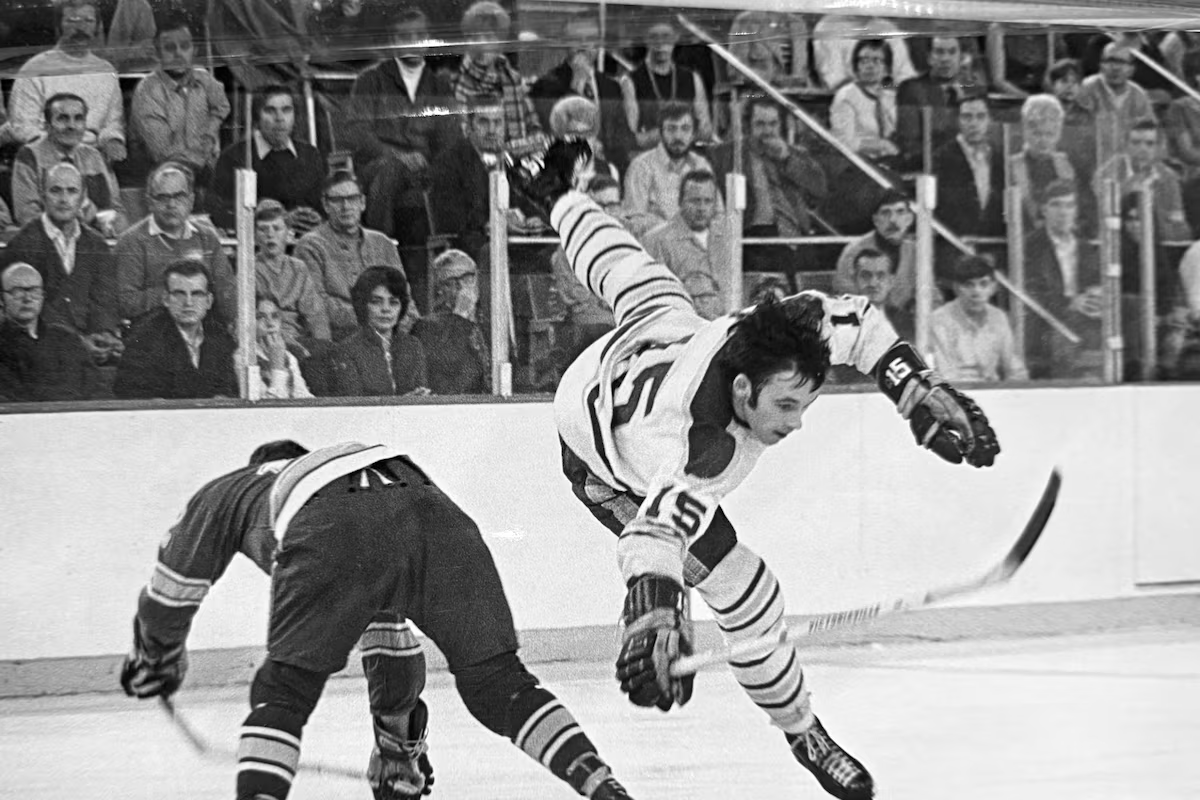

Open this photo in gallery:
Gerry Meehan was never one of hockey’s famous names, but he recorded several historic achievements – on and off the ice.
Mr. Meehan, who died June 5 at the age of 79 following a brief illness, attained a series of firsts as both a National Hockey League player and executive. His accomplishments ranged from earning the Buffalo Sabres’ inaugural assist to helping engineer the first defection of a Russian player, Alexander Mogilny, from the Soviet Union. Mr. Meehan also became one of the first former NHLers to earn a law degree and pioneered analytics and sports-law education programs.
“He made history in a quiet way,” his former Sabres teammate and fellow executive Don Luce said. “He wasn’t flashy, he didn’t want the limelight, he just wanted to do what was right.”
While recording his firsts, he helped many others achieve theirs. Serving as the Sabres’ assistant GM and an adjunct professor at University at Buffalo’s school of law, Mr. Meehan mentored student Helen (Nellie) Drew in sports law. Ms. Drew later became outside counsel to both the NHL and Sabres – after he had performed both roles with the same firm – and she said she was the first woman to attend an NHL Board of Governors meeting or sit in a Sabres board meeting “because of him.”
En route to becoming a sport-law expert, she processed Mr. Mogilny’s successful U.S. asylum application, negotiated Sabres player contracts and helped complete transactions that brought the Anaheim Ducks, Ottawa Senator, Tampa Bay Lightning and San Jose Sharks expansion franchises into the NHL.
“He made my career,” she said of Mr. Meehan. “He gave me an opening.”
Gerard (Gerry) Marcus Meehan was born Sept. 3, 1946 in Toronto. He was the second-oldest of six children, four boys and two girls, born to Frances (née Bergin) and Albert Meehan. His mother was a registered nurse and his father worked in sales.
Open this photo in gallery:
Gerry Meehan as a child.Courtesy of family
Growing up in Newmarket, Ont., Gerry played minor hockey in the private St. Michael’s College School program on an academic scholarship. He rose to the NHL through the Toronto Maple Leafs development system after playing junior for the Toronto Neil McNeil Maroons and Toronto Marlboros, a Leafs affiliate. The Leafs secured his playing rights under a process that allowed the club to protect young players who lived in its designated territory. They selected him in the fourth round, 21st and last overall, in the inaugural NHL amateur draft in 1963. During those years, he became the first member of his family to attend a postsecondary institution, taking courses at the University of Toronto.
In 1967, Mr. Meehan played a leading offensive role as the Marlboros captured the 1967 Memorial Cup, downing the Port Arthur Marrs 4-1 in a seven-game series.
He signed with the Leafs that summer and spent his rookie pro season with their Tulsa, Okla., farm team, helping the Oilers claim their first Central Professional Hockey League championship. Over the next two seasons, he bounced between the Toronto and Philadelphia organizations, realizing a boyhood dream of playing for his hometown team and becoming one of only five players from the inaugural draft class to skate in the NHL.
The Sabres claimed him from Philadelphia in the 1970 expansion draft; in October of that year, he recorded Buffalo’s first-ever assist, penalty and two-point night against the Penguins in Pittsburgh, and his club’s first home-ice goal. Mr. Meehan was named the second captain in Sabres history, helping Buffalo earn its first playoff berth (1972-73) and become a Stanley Cup finalist in its fifth season. But he never got a chance to play in the championship series because he was traded to Vancouver, Atlanta and Washington during two whirlwind seasons. He also served as a captain with the Capitals, enjoying his best seasons offensively, before retiring in 1978, following a brief stint with the World Hockey Association’s Cincinnati Stingers, due to a shoulder injury.
A husband and father of young children, Mr. Meehan quickly sought a new career to ensure that his family was financially secure, knowing that many of his peers were struggling, his son Dan said.
“He always took care of us,” Dan Meehan said. “He didn’t fall victim to the tough afterlife of the 1970s hockey player.”
While still playing, Mr. Meehan had completed his undergraduate degree at Canisius College in Buffalo. From 1982 to 1984, he obtained a law degree from the University of Buffalo and joined the local firm that served as outside counsel to both the NHL and Sabres, advising Buffalo GM Scotty Bowman on player contracts and initiating the development of the Sabres’ current arena, KeyBank Center. In 1984, he joined the Sabres as assistant GM while also working as a TV broadcaster during games and teaching at UB.
Open this photo in gallery:
Gerry Meehan in action playing for the Buffalo Sabres.Courtesy of family
After succeeding the fired Mr. Bowman as GM in 1986, he built the Sabres into a Stanley Cup contender, drafting and acquiring future hall of famers Pierre Turgeon, Dale Hawerchuk, Pat LaFontaine, Dominik Hasek and Mr. Mogilny. In May, 1989, Mr. Meehan and Mr. Luce secretly shepherded the 20-year-old Mr. Mogilny to the United States following the world hockey championships in Stockholm, eluding KGB officers in the process.
Mr. Mogilny’s defection inspired four other future Russian NHL stars – Sergei Fedorov, Vladimir Konstantinov, Pavel Bure and Vyacheslav Kozlov – to defect from the Soviet Union.
During his Hockey Hall of Fame induction speech, Mr. Mogilny called Mr. Meehan and Mr. Luce his “guiding lights” into the league.
Mr. Meehan utilized analytics to help determine which players would perform best – including Mr. Mogilny and Mr. Hasek, who was Chicago’s third-string goaltender before Buffalo acquired him in a lopsided trade in 1992.
“Gerry, Don [Luce] and [assistant GM] Craig [Ramsay] were the first ones to basically take sports statistics out of hockey coaches’ binders and put them into a computerized format,” Ms. Drew said.
But Mr. Meehan regarded analytics as one of many tools and only made deals after verifying the data with his eyes, Mr. Luce said.
“He was meticulous about making trades, knowing every angle of a trade,” Mr. Luce said.
In 1996, following an ownership change, Mr. Meehan resigned as Buffalo’s executive vice-president to pursue his interest in analytics and other ventures. He returned to Toronto with his wife, Mirella Meehan (née Fabris), and helped St. Michael’s College apply for and secure an Ontario Hockey League expansion franchise.
Serving as the team’s president of hockey operations, he hired Scott Secord as assistant general manager. Mr. Meehan and Mr. Secord later partnered on a number of business ventures, including electronic raffle company 5050 Central, which went public; Pointstreak Sports Technologies, which provides hardware, software and data-management-related services for NHL Central Scouting and various other sports organizations; and Sutton Medical Technologies, which digitized NHL players’ medical records, improving players’ health care and keeping GMs honest about trade candidates’ injuries. Mr. Meehan and Mr. Secord also advised young players on U.S. scholarship and junior-hockey options.
Open this photo in gallery:
In addition, Mr. Meehan helped the NHL determine the values of the San Jose Sharks and Columbus Blue Jackets, and assisted the owners of other clubs, including the Sabres and New York Islanders, with putting prices on other clubs before selling them.
In the late 2010s, he and his wife moved back to Buffalo, where he worked with Ms. Drew, now the director of the UB law school’s sports-law program, teaching courses and providing legal services.
Mr. Meehan also helped hundreds of retired players from numerous countries obtain government pension payments that they did not know they were entitled to, according to Glenn Healy, president and executive director of the NHL Alumni Association.
Mr. Healy, an ex-NHL goalie and former Hockey Night in Canada commentator, said he chose Mr. Meehan to help the association’s members without considering anyone else because the former NHL player and executive had taken the “journey” – which they had “no idea of how to navigate” – to securing increased benefits.
“Gerry was willing to dedicate his time, dedicate his energies in a real thoughtful way to make a better tomorrow than today for so many [retired] players and their families,” Mr. Healy said.
Mr. Meehan continued to teach at UB and assist former NHLers until shortly before his unexpected death in a Buffalo-area hospital. He leaves his five siblings; wife, Mirella; their children, Adam, Dan and Kate; and four grandchildren.
You can find more obituaries from The Globe and Mail here.
To submit a memory about someone we have recently profiled on the Obituaries page, e-mail us at obit@globeandmail.com.