
Open this photo in gallery:
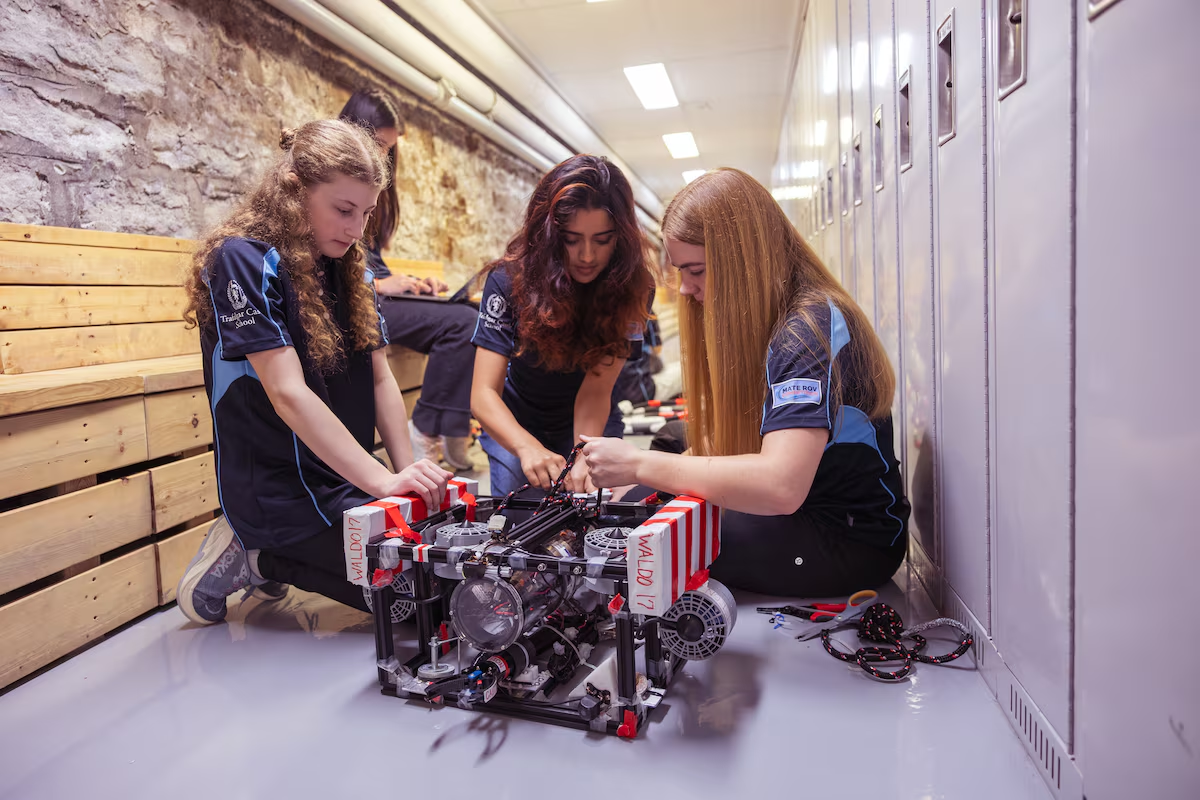
The Where’s Waldo robotics team of Trafalgar Castle School construct the tether for Waldo XVI, their custom-built remotely operated vehicle.Sarah Espedido/The Globe and Mail
Inside the Design Tech Lab at Trafalgar Castle School, an all-girls K-12 private school in Whitby, Ont., the senior robotics team prepares for the biggest competition of its life.
“Are we out of white zip ties?” asks one of the team’s 13 members, all of them between Grades 9 and 12. Behind her, another one is soldering a fuse while the bulk of the group has the “Where’s Waldo 17,” its custom-built underwater robot, out in the hallway testing its controls.
“Do you have the connectors for the cameras,” another student asks as they prepare to take the robot, or remotely operated vehicle, to the pool for some last-minute testing.
Then, the question that might seem a little baffling to an outsider but is just one more query for everyone on their way to the pool.
“Can you bring the iceberg?”
The iceberg in question is a rectangular shape of white plastic tubing, a couple of feet long and about a foot wide with red markings on it. The robot will have to find it and take photographs, which the team will use to render computer models.
“Getting a robot to work is actually much easier said than done,” said Taara Gill, a Grade 12 student and the team’s CEO.
This is the first time the team has qualified for the MATE ROV Competition World Championship, an international three-day contest where teams compete with their remotely operated vehicles to complete simulated missions under water. The competition begins Thursday in St. John’s.
They are also the first secondary school team from Ontario to compete in the Ranger division, home to upper elementary and high-school students.
Regardless of how the team performs, the fact that it qualified is a step toward seeing the historically male-dominated fields of science, technology, engineering and math (STEM) as ones in which women can thrive, Ms. Gill said.
“It changes the narrative of engineering when an all-girls team places,” she said.
The Marine Advanced Technology Education ROV competition was launched in partnership with the Marine Technology Society, an international professional society, to encourage students to develop skills needed by the maritime industry, said Jill Zande, executive director of MATE.
“It really is about engaging students, getting them excited about STEM, helping them to gain exposure to career opportunities in our ocean world,” she said.
Of the nearly 90 teams from 16 countries competing at this year’s world championship, only a few will be all-female teams, Ms. Zande said.
This year, teams will operate their ROVs in the world’s largest flume tank, a 1.7-million-litre facility at the Fisheries and Marine Institute at Memorial University designed to mimic ocean currents.
There will also be testing environments at the National Research Council Canada facility in St. John’s.
Teams will test their ROVs in a range of challenges: grabbing items and bringing them to the surface, counting objects, measuring “icebergs” and more. They will also be acting as startup companies, presenting technical documents and making marketing pitches to a panel of industry experts.
Natalie Calnek, left, and Abeeghaa Nishangan work on the vertical profiler. The vertical profiler is an autonomous underwater robot designed to collect data such as depth, pressure, and temperature.
SARAH ESPEDIDO/THE GLOBE AND MAIL
Natalie Calnek, a 16-year-old member of the Trafalgar team, said being at the world championship might encourage other girls to join a robotics team.
“It provides an opportunity for girls to be interested in engineering, and people who may not have considered it before joining a team like this allows them to see what it could actually be like,” she said.
It is important for women to be in STEM fields because they often bring a different perspective, said Penny Senior, a technology and robotics teacher at Trafalgar Castle School who oversees the team.
“Women think about the ‘why’ more,” she said. “A lot of times when the girls are designing, they’re like, ‘But why would we do this? What is it going to do?’”
But it is also empowering for these students to gain experience early as a foundation for future achievement, she said.
Open this photo in gallery:
Ms. Calnek, centre, lowers the vertical profiler into the pool while other members of the Where’s Waldo team watch.Sarah Espedido/The Globe and Mail
They “have a lot of confidence then to push into engineering and mechatronics and into this new changing world with AI and all of these learning management systems that in the past a lot of women would not have,” she said.
That is why it is so important to get girls interested in STEM as early as possible, Ms. Senior said. “If I can get them excited young then they build that confidence, and they build that interest and energy, and then it takes them up into the high-school years where you become more self-conscious but you’re confident because you’ve been doing it for so many years,” she said.
For Ms. Gill, who will be studying systems design engineering at the University of Waterloo in the fall, the next three days will be a “whirlwind,” she said.
“It’s three days of total, fast paced, everything’s moving, everyone’s talking, things are always happening all the time,” she said.
There will be plenty of stress, but it will be an experience unlike any other, she said.
“I’m just so, so thrilled to be surrounded by brilliant minds from all over the world.”