
Open this photo in gallery:
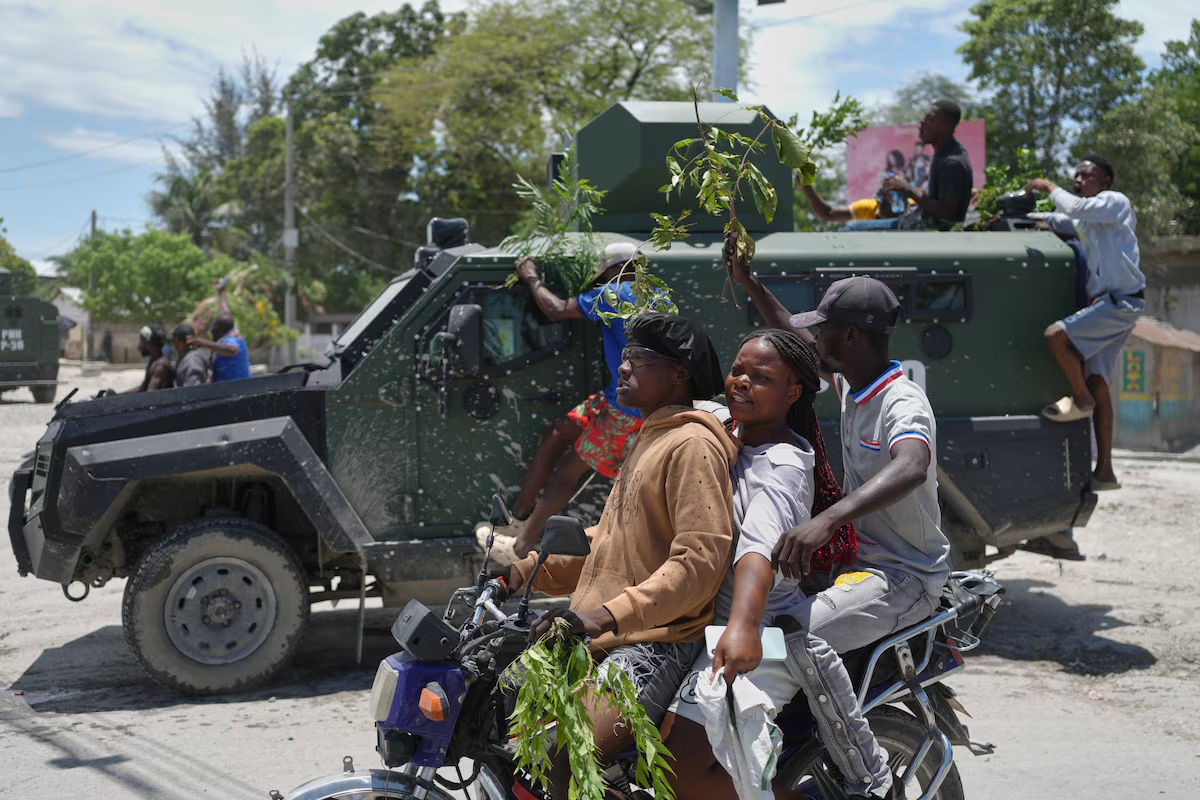
Residents of Cité Soleil celebrate the arrival of armoured police vehicles in Port-au-Prince, Haiti in May.Odelyn Joseph/The Canadian Press
Foreign Affairs Minister Anita Anand announced $35 million in new funding Tuesday for projects aimed at shoring up security and curbing violence in the Caribbean.
Anand was in Panama on Tuesday for meetings of the Organization of American States, a multilateral organization that co-ordinates state efforts on security, democracy and economic development across the Western Hemisphere.
Most of the new funding focuses on the violence and political chaos caused by Haiti’s gang crisis. Armed gangs have controlled much of the country since 2021, including critical infrastructure and food production.
The gangs have caused a major humanitarian crisis, with Washington trying to avoid a wave of asylum claimants and Caribbean states urging the U.S. to stop the flow of American handguns into the region. Canada has targeted members of Haiti’s economic elite with sanctions, arguing they have collaborated with the gangs sowing instability across the country.
Tuesday’s funding includes $7.5 million to support the Haitian National Police service’s fight against the gangs, $6.8 million to help countries in the region stop drug trafficking through better policing and information sharing and $10 million to help launch a task force on drug trafficking.
The funding also covers projects to help Jamaica recover from Hurricane Melissa, a category five storm that was one of the most intense hurricanes ever recorded in the Atlantic.
Some of the funding is also going to support Colombia’s peace process.
Canada has been a major funder of OAS projects, including elections monitoring in South America, and has advocated in recent years for better financing for Caribbean states hit by climate change.
Anand said Canada also has ratified a 1994 convention on gender-based violence which sets obligations for member states on preventing, investigating and punishing violence against women.
A Global Affairs Canada news release did not explain why it took so long for Canada to ratify the convention. Global Affairs said ratifying the convention required consultation with other levels of government and the terms “are consistent with obligations that Canada is already subject to under the international human rights treaties to which it is a party.”
Anand’s office said that, while she was in the region, she also met with her counterparts from Mexico, Brazil and Panama, and the head of the OAS.
The meetings come as Mexican President Claudia Sheinbaum says Canada and Mexico are boosting bilateral trade while working to retain USMCA. They also come as Canada tries to secure a trade deal with a bloc of Southern American countries known as Mercosur.