
Good morning. Canada has long cast itself as a bystander in the illegal wildlife trade, but a new investigation shows the country has become a hub for the global black market. More on that, along with the latest in the Middle East and Ottawa’s nuclear plans. Let’s get to it.
Open this photo in gallery:
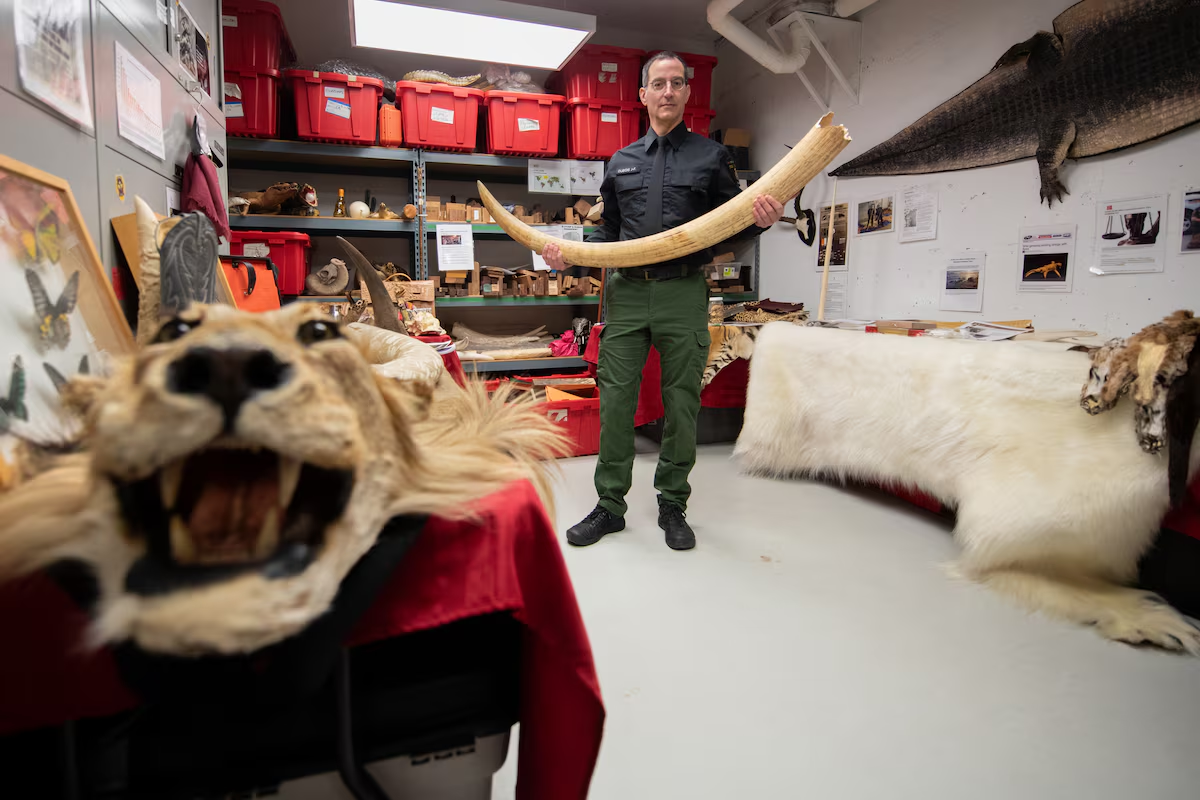
Jean-François Dubois, a senior wildlife officer with Environment and Climate Change Canada, holds an elephant tusk confiscated from a drug dealer’s home.Shelby Lisk/The Globe and Mail
TOP STORY
How the illegal wildlife trade is funding organized crime in Canada
The latest: Canada has become a significant player in the illegal wildlife trade, an investigation by The Globe and Mail and the Pulitzer Center found. The story examines how Canada has become a hub for black-market activity that is flying under the radar, propped up by vast wilderness, patrol blind spots and weak penalties.
How we got here: Unlike drug trafficking, it’s rare for someone involved in Canada’s illicit wildlife trade to land in jail – even though the criminal networks are often exactly the same and profit margins can be much higher. Enforcement offices are understaffed, and many officials say penalties are too low.
How big is the market? While it’s hard to measure precisely, the illegal wildlife trade is believed to be the world’s fourth most lucrative criminal enterprise, only trailing drug trafficking, arms trafficking and human smuggling.
What’s next: There are signs Canada is taking the issue more seriously. It’s participated in international crackdowns on wildlife and forest crimes, and banned the trade of shark fins, elephant ivory and rhino horns. And this past week, G7 leaders pledged joint investigations to trace and seize the proceeds of environmental crime.
Open this photo in gallery:
U.S. Vice-President JD Vance makes an opening statement next to Pakistani Prime Minister Shehbaz Sharif and Qatari Prime Minister and Foreign Minister Sheikh Mohammed bin Abdulrahman bin Jassim Al-Thani in Switzerland on Sunday.Nathan Howard/The Canadian Press
World
Iran and U.S. hold nuclear talks
The latest: U.S.-Iran negotiations on an interim deal to end the war had a tense start in Switzerland as Iranian officials took offence at comments by U.S. President Donald Trump, who threatened to attack and told Iran’s President to watch what he says.
The stakes: The comments complicated efforts by Vice-President JD Vance to discuss Tehran’s nuclear program, the Strait of Hormuz and the unfreezing of billions of dollars in Iranian assets. Iran first wants talks to focus on Lebanon, where Israel’s military has been fighting Iran-backed Hezbollah.
What’s next: After the interim agreement was signed last week, negotiators began a 60-day sprint to reach an agreement on the technical details. A renewed ceasefire in Lebanon brokered on Saturday appears to be holding, but neither Israel nor Hezbollah signed the U.S.-Iran deal.
Open this photo in gallery:
Ocean Smid participates in dance class at Canada’s National Ballet School in Toronto in May.Melissa Tait/The Globe and Mail
How We Live
Dreams of ballet
The latest: The 26 students graduating from Canada’s National Ballet School this month will embark on their careers in a changing industry, as a new ethos of inclusion and belonging transforms dance training. It’s a pivotal moment – a time of big news and even bigger decisions.
What’s next: Only two dancers in the class have been offered contracts at professional companies, while others will continue their training or hang up their shoes and pursue academics instead. Globe writer Martha Schabas got to know three students over the past year and checked in this spring to learn what they’ve decided.
Energy
Ottawa’s nuclear plans
The latest: The Canadian government wants to dramatically scale up the use of nuclear power, with a goal of up to 10 new large-scale reactors, according to a policy document set to be released today. It would be a massive increase: The country now has 17 operable reactors, and the last large reactor was completed in 1993.
The context: Large-scale nuclear reactors are expensive and difficult to build, and the strategy has no new money attached. Power generation and electrical grids are also the sole domain of provinces and territories, so Ottawa hopes to push premiers to action with incentives and its bully pulpit.
What’s next: Federal Energy Minister Tim Hodgson is set to meet with his provincial and territorial counterparts in Yellowknife this week. The strategy promises to rely on existing funds and to release a nuclear-power financing policy by April of 2027.
Crime
How short-term rentals fuel human trafficking
The latest: Traffickers are increasingly turning to rental platforms such as Airbnb and Vrbo because the units are concierge-free, often face little regulation and offer more privacy. While staff who work at major hotels are trained to see warning signs of trafficking, it’s not expected from short-term rental hosts.
What can be done? Municipalities have been slow to address the problem – except Winnipeg, which has created new regulations such as a rule that short-term rentals must display signs with information about human trafficking. Though measuring their effectiveness is difficult, advocates say those efforts should be adopted elsewhere.
Bookmarked
- Abroad: British Prime Minister Keir Starmer says he will resign by September.
- World Cup: Facing the prospect of U.S. visa denials, many Ivory Coast fans are coming to Canada instead.
- For your finances: Tim Shufelt warns there’s a big, fat asterisk hanging over the stock market frenzy.
- Conversation starter: A British art historian believes he has uncovered the identity of the subject for Johannes Vermeer’s Girl with a Pearl Earring.
The Quote
“Why are so many people in China raising pets now? … I think it’s largely because young people − whether due to consumption power, financial situation or work-life balance − find it hard to have enough time and energy to raise a child.”
— Li Jingyuan, founder of AI-driven animal translator PettiChat
China’s most prominent protest in years was sparked not by a demand for greater democracy or allegations of corruption, but animal cruelty. It’s emblematic of how central pets have become to Chinese life – and how much more so they may become as the country’s birth rate plummets.
The Shot
Open this photo in gallery:
Mahikan Nabi, this year’s valedictorian at Bedford Road Collegiate, sits outside the high school in Saskatoon last Thursday.Liam Richards/The Globe and Mail
As the class of 2026 enters a world rocked by climate change, global conflict and the rapid rise of AI, The Globe spoke to five high-school valedictorians about their graduation speeches and how they hope to inspire their peers.