
Open this photo in gallery:
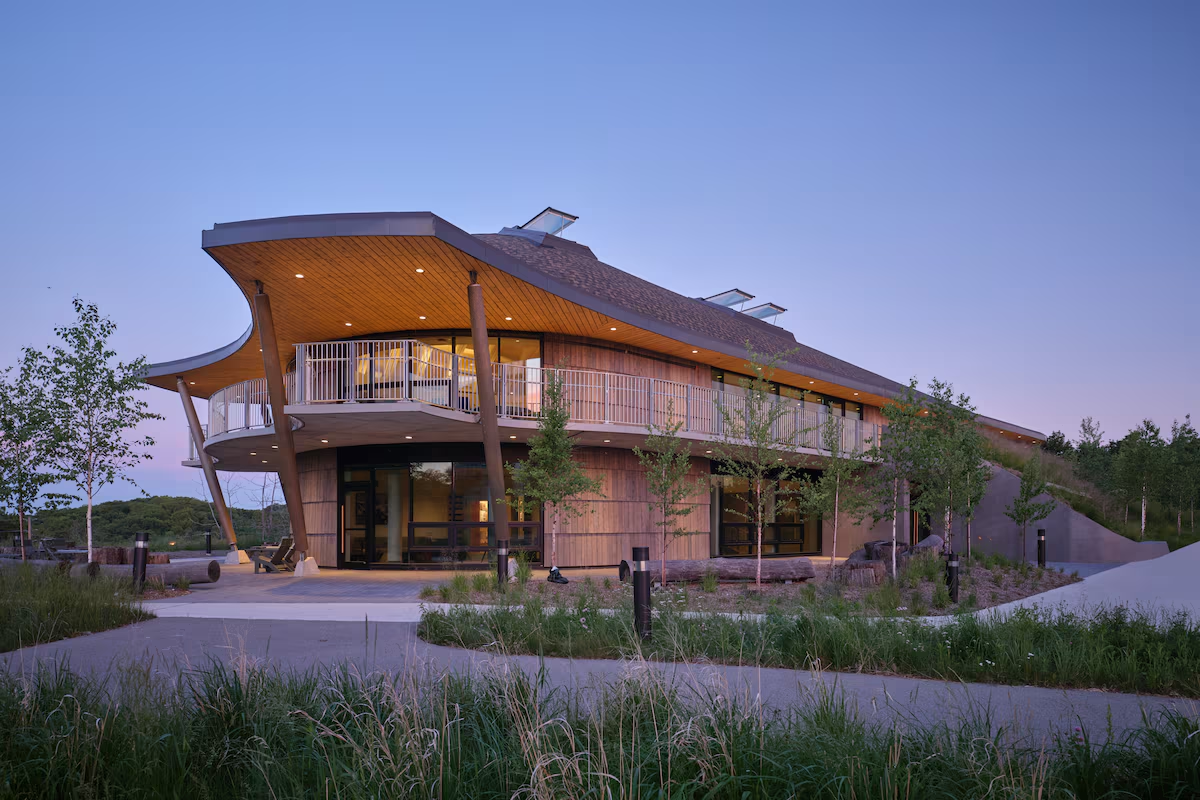
The Indigenous House at the University of Toronto Scarborough was designed to look like it is coming out of the landscape.Doublespace Photography/Supplied
On a sunny spring morning, wood smoke rose from a ceremonial fire and drifted into the Highland Creek Valley. On its way, the stream of smoke crossed a low, rounded roof shingled in cedar shakes, framed by a fringe of grasses and lined by people in celebratory dress.
This was opening day for Indigenous House at the University of Toronto Scarborough, and the place was already bringing people together. Students and visitors ascended ramps on the outside of the long, mound-shaped building to look out on the green of the river valley.
In this 10,700-square-foot pavilion – a collaboration between Vancouver’s Formline Architecture + Urbanism and Toronto’s LGA Architectural Partners – landscape and structure do not merely meet: They are tightly braided. The oval-shaped footprint holds two generous assembly spaces for pedagogy and ritual, alongside offices and a central atrium. Overhead, a sweeping, curved roof of glue-laminated softwood hangs like an inverted basket, a modern engineering feat that echoes ancient building technologies.
The building’s mandate, as Shannon Simpson, U of T’s director of Indigenous initiatives, put it at the opening ceremony, is to “strengthen relationships with Indigenous peoples and to create environments grounded in respect, reciprocity and care.”
For the designers, fulfilling that promise meant seeking a pan-Indigenous approach. “You find a common thread,” noted Formline founder Alfred Waugh, a member of the Fond du Lac Denesuline Nation. “Places like this have to be something that everybody can relate to – Indigenous communities from across the country, and Inuit people, too.”
The design draws inspiration from different Indigenous building traditions – the Eastern wigwam and the West Coast longhouse. Begin with the white cedar shakes on the roof, which nod to the building practices of Great Lakes Indigenous peoples. “They used to peel bark from trees in order to clad a wigwam, and the bark was held by saplings,” Mr. Waugh explained. “We wanted to create a contrast between this very modern building and something that links us back to the past.”
Open this photo in gallery:
The curved roof pays homage to traditional Indigenous longhouses.Doublespace Photography/Supplied
The building’s two ends hold circular gathering spaces that evoke wigwams. Between them, an elongated volume forms an atrium, its long curved roof recalling the longhouses of the Pacific Coast.
The building is halfway in the ground. The university wanted the larger of the two gathering space on a higher floor to enjoy better views, explains UTSC chief administrative officer Andrew Arifuzzaman; the architects figured out how to integrate both levels with the ground.
The earth rises from north to south along the building’s flanks, berms of concrete and earth topped by a gentle ramp that guides visitors to the upper level. “A lot of modern architecture tries to blend inside and outside,” Mr. Waugh says. “This building actually comes out of the landscape.”
There are also views south across Ellesmere Road toward the adjacent river valley, and east to a landscape that is an integral part of the project. Landscape architects PUBLIC WORK collaborated on the garden with Nikibii Dawadinna Giigwag, a program that connects Indigenous youth with professional landscape architects. One hundred and fifty trees and 5,000 perennial plants join benches filleted out of salvaged oak. Behind them, pine logs have been left to break down and sustain a new grove of trees.
Open this photo in gallery:
The design was a collaboration between Formline Architecture + Urbanism and LGA Architectural Partners.Doublespace Photography/Supplied
Bringing that tactile language into the building itself demanded collaboration. Architect Drew Adams, who was project architect with LGA, pointed out the dual-curve subtlety of a wood-clad ceiling: “The contractors thought this was impossible,” he recalled. “We said, ‘Let’s give it a try.’ ” Through what the architects describe as a highly collaborative, iterative process, they achieved exceptional results. Very few buildings today achieve such levels of craftsmanship.
But it is in the DNA of this place. U of T Scarborough includes one of the best and most overlooked buildings in Canada, completed in 1966 by the Australian architect John Andrews and now named for him. The Andrews Building is a terraced ridge of poured concrete that traces the edge of the valley.
While the two buildings may seem like opposites, they share an interest in texture and materials. Mr. Andrews’s concrete was variously poured and molded and hammered. Terracotta tile and oak railings provide earthy counterpoint. It is architecture you want to touch. So is Indigenous House, which resists the 21st-century architectural calculus of panelized metal and plastic. Inside, the stairs are lined by a maple handrail; outside, the learning space gets a sinuous cedar banister. “You enter through a group of trees, and you make contact with wood right away,” says Mr. Adams.
This building should, as intended, make Indigenous students and faculty feel anchored on the campus. But it also offers a vital blueprint for the rest of the discipline. It is an architecture that pays attention to the sun and soil, honours the comfort of the body, and defends the virtues of generosity and longevity. “This place is not just exclusively for Indigenous people,” Mr. Waugh told me. “It is for everybody to take note: Maybe we can do buildings differently.”