
Open this photo in gallery:
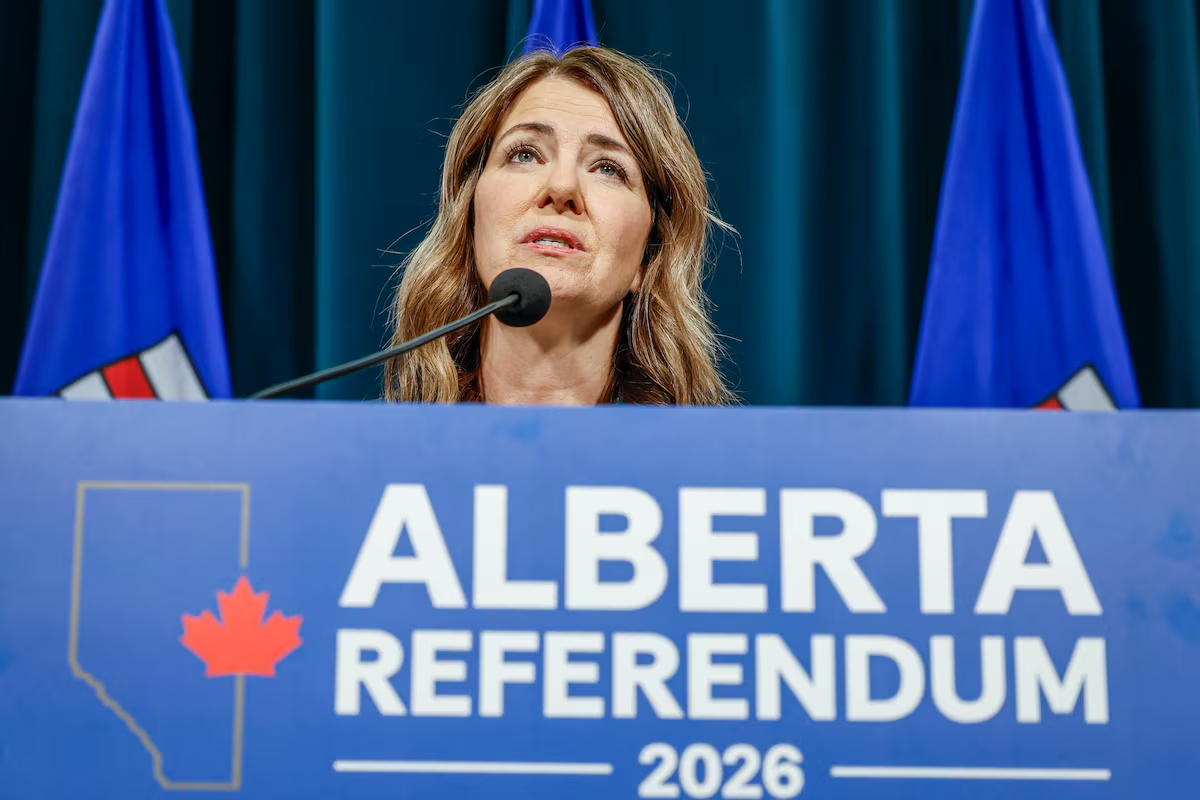
Alberta Premier Danielle Smith’s fall referendum on secession and other issues is scheduled to precede the next provincial election by one year.Jeff McIntosh/The Canadian Press
Last month, Alberta’s chief electoral officer described a government agency in overdrive.
Gordon McClure said that in his 18 months leading Elections Alberta, it had run out of space. Call centres were operating out of boardrooms while other teams were working in the agency’s warehouse. Employees had moved to a “constant state of readiness,” he said, meaning voting materials were ready to deploy at a moment’s notice, and vendor contracts were in place should the government call a snap election.
“I used to drink from a garden hose. Now I’m drinking from a firehose,” Mr. McClure told the standing committee on legislative offices on May 11.
His description offered a rare glimpse at the inner workings of Elections Alberta, the normally quiet government body that has become one of the province’s most consequential agencies. In the past several months alone it has been tasked with administering a referendum, hiring tens of thousands of temporary employees and setting up a team to assess disinformation threats. Currently, it is sitting in the eye of a hurricane, preparing to hold two provincewide votes almost exactly 12 months apart.
The first, a referendum on immigration policy, constitutional issues and provincial secession, is scheduled for Oct. 19, 2026. It will be followed by Alberta’s general election, which can be held no later than Oct. 18, 2027.
Much of the work in front of Elections Alberta has been spurred by a pile of legislative changes introduced by Premier Danielle Smith’s government aimed at paving the way for citizen-led efforts to put provincial policy on the ballot.
Alberta appeal court judge concerned about decision to block separatist petition
For starters, Elections Alberta has been tasked with verifying hundreds of thousands of signatures attached to a flurry of petitions trying to force votes on a range of topics. The petitions – which leverage the province’s direct-democracy laws introduced in 2021 by former premier Jason Kenney and subsequently tweaked by Ms. Smith – have focused most notably on provincial independence, but also on issues such as coal mining in the Rockies.
Those efforts kicked off almost in parallel with a surge of frustrated voters attempting to put several MLAs’ seats to a ballot using Alberta’s recall laws, also introduced in 2021. While all recall petitions – 28 by final count – failed to gather enough signatures to force votes, Elections Alberta stood ready, interviewing roughly 400 people in preparation, Mr. McClure told the committee in May.
“It all came together in a very fine storm,” he said.
The Oct. 19 referendum will be the first time Elections Alberta has held a provincewide vote since the 2023 provincial election, an exercise that looks quaint in hindsight.
Last week, the agency began a record hiring spree to bring between 60,000 and 90,000 election workers on board for the referendum – numbers that rival the population of several Alberta municipalities. In comparison, Elections Alberta hired roughly 13,000 election workers for the 2023 vote.
It could prove to be a challenge. Keith Archer, a former chief electoral officer for British Columbia, said electoral agencies across Canada have struggled in recent years to recruit election workers. He expects Elections Alberta will need to source help from anywhere it can, such as universities or election workers from neighbouring provinces.
“One of the challenges of the election business is there’s a number of requirements of the process that aren’t negotiable,” he said. “Doing it late is not negotiable. Having voting places open on time – it’s just not negotiable. So you have to try to find creative ways to achieve those objectives.”
Open this photo in gallery:
Voters line up in Calgary to cast their ballots in the 2023 provincial election.Jeff McIntosh/The Canadian Press
The referendum’s material needs are also colossal: With 10 questions – each of which will appear on separate, coloured paper ballots – Elections Alberta is preparing to print 45 million sheets. By comparison, in 2023 the agency printed ballots for each of Alberta’s 2.9 million electors and an extra, unspecified amount to account for damaged or spoiled ballots.
The referendum results must be counted by hand, after Ms. Smith banned electronic tabulators earlier in her term.
“The more you describe it, the more daunting it becomes,” Mr. Archer said of the referendum.
Mr. McClure said in May that he will outline the costs of holding the referendum closer to the vote and will be asking for more funding so that he can then prepare for the 2027 general election.
Elections Alberta spent roughly $37-million on the 2023 provincial election. Maia Hanrahan, a spokesperson for Elections Alberta, did not say how much the agency expects the fall vote to cost, but said “the scale of this referendum is much larger.”
This week, Alberta Finance Minister Jason Nixon disputed that the referendum would be more expensive than a provincial vote.
“We’ll make sure Elections Alberta has the resources to do the job that they need to do, but I can’t see why a provincewide vote would cost any more than it would cost to run a general election,” Mr. Nixon said at an unrelated news conference.
With Alberta set to hold separation referendum, these groups are vying to shape opinion
While the referendum has largely sapped Elections Alberta’s resources, much of the general election prep work can’t begin until the government finalizes Alberta’s electoral boundaries, a process that Ms. Smith’s government controversially upended in March. Mr. Archer said the electoral map determines everything from how many ballots are ordered for each riding to the number of chairs local officials need on voting day.
“All of that work … is the backbone of how the election is administered,” he said. “That doesn’t begin until those maps are in place.”
The late-October deadline to finalize the electoral map – in addition to debating and passing it when the legislature resumes at the end of that month – means Mr. McClure’s team will have less than a year to fully prepare for the general election, a job that normally takes a minimum of 18 months.
On top of the two votes, Elections Alberta has also created a team in response to laws passed by Ms. Smith’s government that give the chief electoral officer the authority to request deepfakes of public officials be removed from the internet to combat disinformation. (Deepfakes are photos or videos that have been edited or generated by artificial intelligence.)
On June 1, the agency started its Information Integrity Unit, created to meet the legislation’s expectations. Elections Alberta did not say how many people are on the team, but it will outline how many full-time employees are needed in future budget requests.
Ms. Hanrahan, with Elections Alberta, said the unit will eventually partner with the federal Foreign Influence Transparency Commissioner, a position that will be charged with managing a yet-established public registry of foreign influence activities in Canada.