
Good morning. Fertility rates are steadily declining in Canada. So why does data show that men are still interested in being a parent? More on that below, along with updates from Ukraine and Cuba. But first:
Today’s headlines
Open this photo in gallery:
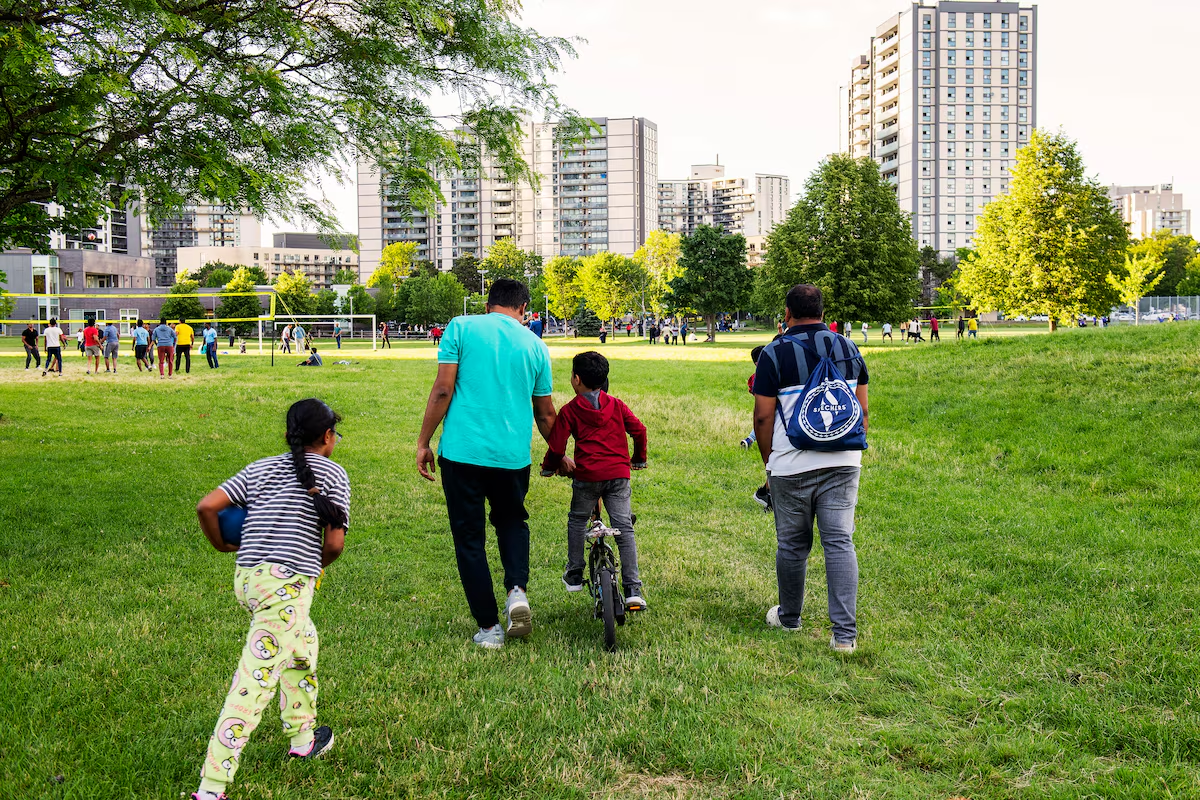
Children and adults enjoy the playground at Parkway Forest Park in North York, Ont. In Canada, almost 49 per cent of men and 42 per cent of women want to become parents.DUANE COLE/The Globe and Mail
Generations
The changing face of fatherhood
Young people aren’t interested in having kids. Or so the thinking goes.
Much of the discussion around fertility rates here in Canada, for obvious reasons, has focused around women.
But with Father’s Day just around the corner, it seemed like a good time to check in on young men. And, it turns out, the data there paints a slightly different picture.
Young men still want to become dads. Men in Canada and the U.S. are more likely to say they want kids than women. In Canada, it’s almost 49 per cent of men, compared with 42 per cent of women. In the U.S. the contrast is starker: 57 per cent of men compared with just 45 per cent of women.
Not only does this challenge our cultural assumptions – the cliché that men have to be “dragged” into fatherhood – but also our ideas about behaviour in times of uncertainty (think: cost of living, climate, employment, etc).
Open this photo in gallery:
I’m Ann Hui, the Globe’s generations reporter. Over the past year, I’ve been writing about falling fertility rates. In today’s edition of The Globe, I look at the question of why it is that, at the same moment young women are turning away from parenthood, young men seem to be turning towards it.
As part of my reporting, I spoke with Jonathan Allan, a professor of gender studies at Brandon University in Manitoba, who focuses on masculinity. Here are some of his ideas on why this might be the case:
How has fatherhood changed over the past couple decades?
If you go to the playground today, you’re likely to see dads hanging out there with their kids. They’re going to the park and playing with their kids. They’re dropping kids off at school. Picking kids up from school. Clearly, something’s changed.
You can’t be a father and ignore your kids now. Not only is it socially acceptable to care for your children, it’s socially expected. The worst thing anybody can say to me is, “Oh, you’re babysitting the kids.” Like, no, they’re my kids.
It’s an idea that holds true across class and geographical divides. I was part of a study on rural men and masculinity, and what we found was that the men there, too, were interested in improving as fathers.
At the same time, our ideas around traditional masculinity have changed. How has that affected fatherhood?
It’s confusing, in a sense, right? Because you’ve got these really diverse, polarizing views, and how do you square that? There’s the manosphere, and all the “make masculinity great again” stuff. And then you have other folks saying we need to let go of all of that toxic stuff. So there’s a world of possibilities out there.
There’s also the crisis discourse – the idea that masculinity is in crisis. That’s not new. Every generation, going back to even the 1880s, we’ve seen it. There’s a famous quote from one of Henry James’s novels where one of the characters complains about the “damnable feminization of men.”
So, sure, it’s confusing. But I’m sure it’s confusing to be a woman in this society, too. Society is confusing at times.
Open this photo in gallery:
Brandon Hay plays a game of dominoes with his sons Tristan, Julian and Elijah.DUANE COLE/The Globe and Mail
Dads today are expected to take on much more of the childcare duties than previous generations. And yet, men still want to be dads. Why do you think that is?
I think it’s still a rite of passage. It’s still one of those markers of success in life. I also think for young men, being a dad is a world of possibility.
Masculinity is still there. We still have expectations of it. But now men can be tender and tough. They can be compassionate and strong. And expressing a desire to be a father is an interesting example of this: tenderness and toughness.
Another big thing that I’ve seen is this idea of being a better dad than their dad. It doesn’t have to mean that their dads were bad. But they want to see a way to do dadhood differently. I think that’s exciting.
This interview has been edited for clarity and length.
The Shot
‘If Ukraine is going to burn, your Moscow will burn too.’
Open this photo in gallery:
Black smoke rises from a Moscow oil refinery on Thursday after a Ukrainian drone attack.-/AFP/Getty Images
Kyiv struck a major Moscow oil refinery in a bid to draw Russian President Vladimir Putin to the negotiating table. Meanwhile, Ukraine’s Volodymyr Zelensky signed an agreement with other EU leaders to develop an air defence system to counter ballistic missiles.
The Wrap
What else we’re following
At home: A 19-year-old fugitive accused of shooting at the U.S. consulate building in Toronto in March has been arrested, ending a weeklong public manhunt.
Abroad: Cuba’s Communist Party approved an emergency economic package featuring unprecedented free-market measures aimed at opening up the struggling country’s economy.
Community healing: Ottawa and B.C. will contribute $200-million toward a new high school and health centre in Tumbler Ridge.
Film: At the Banff World Media Festival, the Canadian film and television industry grappled with a mountain of trade troubles.